
Reviewed · POMPEII TOURS
Private Transfer: Naples to Sorrento with Pompeii Guided Tour
The most useful part of this experience is the way it joins three jobs into one: pickup in Naples, a guided visit to Pompeii, and drop-off in Sorrento. You do not need to haul your bags onto a train, work out a Pompeii connection, then find another ride along the coast.
I like the flexible pickup time and the door-to-door finish. I also like the two-hour official-guided walk, which gives you a clear route through Pompeii instead of leaving you to wander among ruins with no context. The main drawback is the price: at $492.76 per person, it makes the most sense for a small group that values time and convenience.
In This Review
- Key points at a glance
- Why this Naples to Sorrento transfer is useful
- What the private vehicle changes
- Entering Pompeii with a two-hour guide
- The Forum and Temple of Jupiter
- Macellum and Via dell’Abbondanza
- The Stabian Baths and daily Roman life
- The Lupanar and a less polished side of Pompeii
- The House of the Faun
- Teatro Grande and the Basilica
- Timing, heat, walking, and the missing lunch break
- Is $492.76 per person a fair price?
- One important warning about the attached feedback
- Who should book this experience?
- Should you book the Naples to Sorrento Pompeii transfer?
- FAQ
- How long does the experience last?
- Where can I be picked up in Naples?
- Where will I be dropped off in Sorrento?
- Is Pompeii admission included?
- Is a guide included at Pompeii?
- What language is the Pompeii tour offered in?
- Is transportation private?
- How much luggage can I bring?
- Are meals and drinks included?
- What should I wear for Pompeii?
- Can I cancel for a full refund?
Key points at a glance
- A transfer with a real sightseeing stop: You travel from Naples to Sorrento while fitting in Pompeii along the way.
- Two hours with an official guide: The route covers the Forum, temples, baths, shops, homes, theater, and basilica.
- Skip-the-line Pompeii admission included: You do not have to arrange the entrance ticket separately.
- Flexible Naples pickup: Collection is available from a hotel, airport, train station, or port.
- Luggage-friendly private transport: The vehicle is air-conditioned and designed to carry bags, within stated limits.
- Best for a tight arrival day: This works especially well when you want to reach Sorrento without giving Pompeii a separate half-day.
Why this Naples to Sorrento transfer is useful
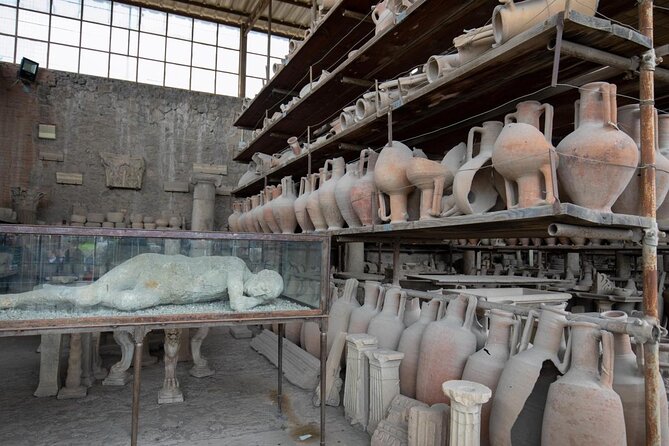
Pompeii sits naturally between Naples and Sorrento, but getting there with luggage can be awkward. A local train may be inexpensive, yet you still need to manage your bags, locate the correct station, and arrange onward transport after visiting the ruins.
This private service removes that chain of small problems. Your driver meets you at the agreed Naples location, holds a board with the lead passenger’s name, and carries you to Pompeii. After the guided walk, you continue directly to your chosen address in Sorrento.
That makes the experience less about adding another excursion and more about using a transfer day wisely. You can turn a necessary move between cities into a worthwhile archaeological visit.
The advertised duration is about four to five hours. The Pompeii visit itself lasts two hours, so the remaining time covers pickup, driving, entry, meeting the guide, and the final run to Sorrento. I would keep your schedule loose after arrival. Traffic, loading luggage, and the size of the archaeological site can all affect the exact finish.
More ways to see Pompeii:
- From Naples: Pompeii Ruins & Mount Vesuvius Day Tour
★ 4.3 · 11,459 reviews - Naples or Sorrento: Full-Day Pompeii and Mount Vesuvius Tour
★ 4.6 · 4,235 reviews - Pompeii & Mt.Vesuvius Day Tour from Naples with Pizza Lunch
★ 4.0 · 2,901 reviews
What the private vehicle changes
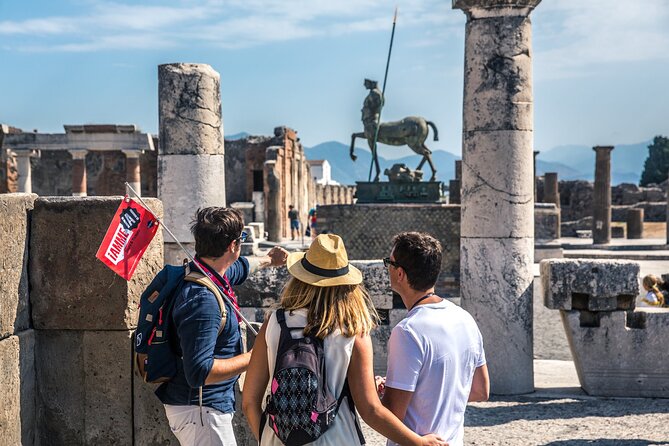
The vehicle is air-conditioned and has room for luggage. That matters in southern Italy, especially in summer, when Pompeii offers little shade and the heat can build quickly.
Pickup can be arranged at your Naples hotel, airport, train station, or port. For airport or station pickup, provide your flight or train number. You also need to provide the full Sorrento drop-off address when booking, not simply the name of the town.
The private format means only your party participates. You avoid the uncertainty of a large coach schedule and can set a pickup time that fits your arrival. You still need to be ready at the agreed time, since a private transfer is not an open-ended taxi service.
There is a stated luggage allowance of one medium or large suitcase per passenger seat, plus one small item such as a laptop bag, camera bag, or small shoulder bag. If your party has oversized cases, several large bags, or unusual equipment, contact the provider before booking to confirm the vehicle capacity.
The driver speaks English or Italian. The Pompeii tour operates in the language selected at booking. That distinction is useful: the driver is primarily handling the transfer, while the official local guide provides the archaeological commentary.
Entering Pompeii with a two-hour guide
Pompeii is too large to understand well by simply ticking off buildings. You can spend hours walking over its ancient streets and still miss how the city worked. A two-hour guided route gives you a framework.
The city was buried after Mount Vesuvius erupted in AD 79. Ash, pumice, and volcanic material covered homes, streets, public buildings, shops, and household objects. The eruption was destructive, but the burial also preserved an unusually detailed picture of Roman urban life.
The guide’s job is not just to point at old walls. You should expect help reading the street plan, identifying public buildings, and understanding how houses, businesses, religion, entertainment, and politics fit together. The listed route concentrates on major sites, which is a sensible choice when your visit is limited to two hours.
You may not see every corner of Pompeii. That is the tradeoff. This is a highlights walk, not a full-day archaeological study.
The Forum and Temple of Jupiter
The Civil Forum is the logical beginning of the visit. It was the center of public life, with buildings connected to administration, justice, business, markets, and worship.
The open square gives you a quick sense of Pompeii’s scale and organization. Look toward the north side for the Temple of Jupiter, the Capitolium of the city. Its position made it one of the most commanding buildings around the Forum, with Vesuvius rising behind it.
The temple honored Jupiter, Juno, and Minerva. The guide can help explain how Pompeii changed after it became a Roman colony in 80 BC and how the religious setup echoed Rome’s own Capitolium.
The Forum is also one of the places where crowds can gather. Stay close enough to hear the guide, especially if other groups are moving through the same area.
More Sorrento days from Naples:
- From Naples: Sorrento, Positano and Amalfi Full-Day Tour
★ 4.6 · 10,988 reviews - From Naples: Sorrento, Positano & Amalfi Coast – Small Group Tour
★ 5.0 · 8,643 reviews - From Naples: Premium Tour of Sorrento, Positano, Amalfi
★ 4.8 · 3,606 reviews - From Naples or Sorrento: Pompei Half-Day Tour
★ 4.4 · 2,645 reviews
Macellum and Via dell’Abbondanza
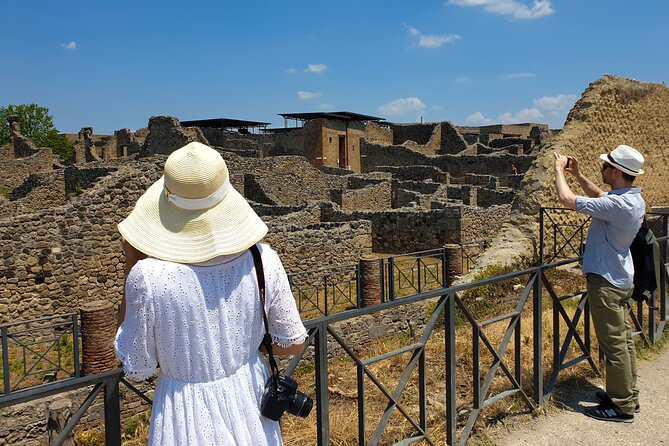
The Macellum was a market building with a religious role as well. Its covered portico, raised worship area, rooms for a sacred board, and masonry counter show that commerce and public religion were often mixed together.
A counter that may have been used for selling fish offers a small but helpful reminder: Pompeii was not just a collection of grand temples and wealthy houses. It was a working city with food sellers, tradespeople, customers, officials, and ordinary routines.
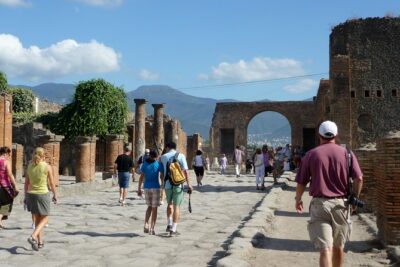
Next comes Via dell’Abbondanza, the city’s main east-west street. In Roman times, it was lined with shops, workshops, cafes, snack bars, and restaurants. This is one of the most readable parts of the ruins because the street itself helps you imagine movement and noise.
Watch your footing. Ancient paving stones are uneven, and the route involves steady walking. Comfortable shoes are not optional decoration here. In summer, sunscreen, water, and a hat are wise choices, though lunch and beverages are not included in the tour.
The Stabian Baths and daily Roman life
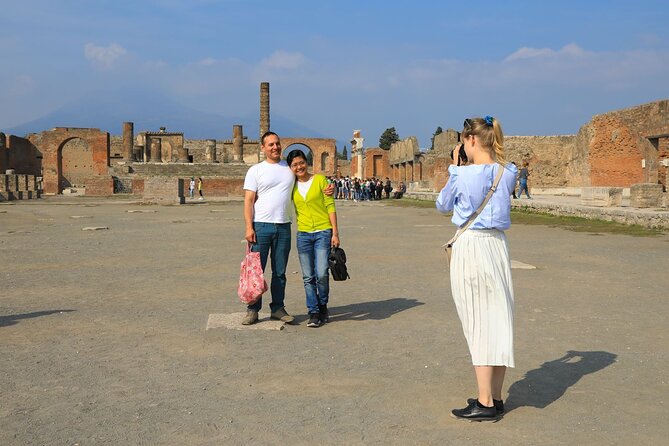
The Stabian Baths date from the period soon after the settlement of Sulla’s veterans in 80 BC. Separate men’s and women’s sections, dressing rooms, hot rooms, warm rooms, and cold rooms reveal how much planning went into Roman bathing.
The men’s section includes an apodyterium, or changing room, along with spaces used for cold, warm, and hot bathing. These were social buildings as much as washing facilities. A visit here gives you a better sense of ordinary public life than another grand monument alone can provide.
The baths were badly damaged by the earthquake of AD 62, seventeen years before the eruption. That detail helps explain why some buildings in Pompeii look unfinished or partly repaired. The city was already dealing with major damage before Vesuvius buried it.
The Lupanar and a less polished side of Pompeii

The Lupanar is Pompeii’s best-known brothel. It is a small two-story building with five ground-floor rooms, built-in masonry beds, erotic frescoes, and visitor graffiti.
The paintings above the doors may have helped customers identify the services offered. The graffiti provides a blunt glimpse into the language and social habits of ancient residents.
This stop can be crowded and is not the quietest part of the route. It is also more explicit than the temples and villas, so families may want to decide in advance how they wish to handle it. The guide can provide context, but the building itself is compact, and you may have only a short time to look before the group moves on.
The House of the Faun
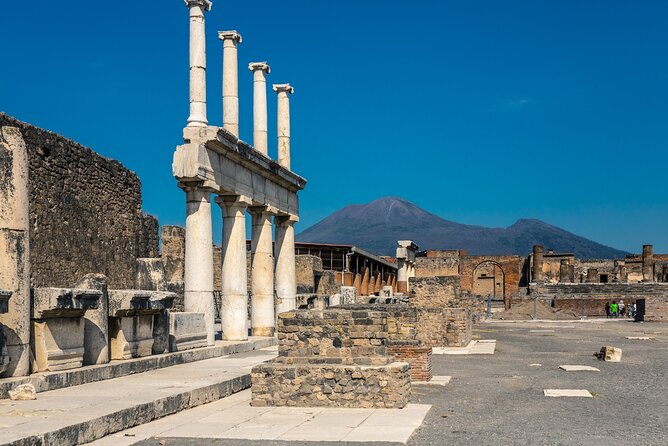
The House of the Faun was one of Pompeii’s largest and most impressive private homes. Built in the second century BC, it reflects the wealth of an aristocratic Roman family and the importance of displaying status inside the home.
The house is valuable because it shifts your attention from public Pompeii to private life. Its size, layout, and decoration show how the city’s elite entertained, received clients, and presented themselves.
Do not expect to examine every room in detail during a two-hour route. The purpose here is to understand the difference between an ordinary commercial street and an aristocratic residence. Your guide can point out the features that make the house important without letting this one building consume the whole visit.
Teatro Grande and the Basilica

The Large Theater used the natural slope of the ground to create its auditorium. It hosted tragedies drawn from Greek and Roman traditions, giving Pompeii a formal place for public entertainment.
The theater is a good stop for seeing how Roman builders worked with the existing terrain. It also reminds you that Pompeii was not merely a commercial town. People came together for performances, civic events, worship, business, and legal matters.
The Basilica, located by the Forum, was the city’s grand business and justice building. Its roughly 1,500-square-meter footprint made it one of the Forum’s most important structures.
The contrast between the theater and basilica helps round out the visit. One served public performance, the other commerce and law. Together with the baths, market, streets, temples, and houses, they make the city feel organized rather than random.
Timing, heat, walking, and the missing lunch break
The tour lasts four to five hours, but the Pompeii section is a focused two-hour walk. You should treat it as a substantial outdoor visit, not a quick photo stop.
Pompeii can be very hot in summer. Much of the route is exposed, and the ancient paving can be rough. Wear firm, comfortable shoes, use sunscreen, and carry water. The tour does not include lunch or beverages, so plan around that before pickup or ask the provider what timing is practical for your departure.
Because this is also a transfer, the day has a built-in time limit. You will not have unlimited freedom to stop at every house or return to a favorite street. If your main goal is detailed photography, quiet exploration, or lesser-known sections of the site, arrange a longer Pompeii visit separately.
Is $492.76 per person a fair price?
The cost is high if you compare it with buying a basic train ticket and Pompeii admission on your own. It becomes more reasonable when you are traveling with several people and would otherwise need separate taxis, luggage storage, entrance tickets, and a guide.
The price includes Naples pickup, private transport, air conditioning, Pompeii admission, skip-the-line entry, an official local guide, and delivery to your Sorrento accommodation. It does not include food or drinks.
For one or two people on a strict budget, the service may feel expensive. For a family or small group arriving with luggage, the convenience has real value. You are paying for saved time, fewer transfers, and a simple handoff from Naples to Sorrento.
A group discount is offered, but the exact reduction is not stated here. Check the final price for your party before committing.
One important warning about the attached feedback
The supplied rating is 4.2 from 40 reviews, but the written comments provided with it describe boat excursions to Capri, including swimming stops, captains, funicular queues, and Blue Grotto arrangements. Those details do not match this Naples to Pompeii to Sorrento transfer.
That mismatch matters. You should not book this service expecting a boat ride, Capri time, snorkeling, or a captain named Giovanni, Pino, Marco, or another person mentioned in those comments. The experience described here is a land transfer with a guided Pompeii visit.
The relevant practical lesson is simple: confirm the exact pickup point, language, luggage capacity, and Sorrento address before departure. Product information can sometimes be grouped with feedback from another excursion, so read the actual inclusions carefully.
Who should book this experience?
I would choose this for you if:
- You are arriving in Naples and staying in Sorrento next.
- You have luggage and do not want to use several public transport connections.
- You want a clear introduction to Pompeii rather than a full archaeological day.
- You are traveling with family or friends and can share the private vehicle cost.
- You value a fixed pickup and door-to-door finish.
I would look elsewhere if you want a low-cost transfer, a slow Pompeii visit, a long lunch, or time for sections beyond the main highlights. A separate Pompeii tour may suit you better if the ruins are the central purpose of your day.
Free cancellation is available up to 24 hours before the scheduled start time. Changes or cancellations inside that window are not accepted for a refund.
Should you book the Naples to Sorrento Pompeii transfer?
Book it if your arrival and transfer day are already fixed and you want Pompeii included without carrying your bags through a chain of connections. The official guide, skip-the-line admission, private vehicle, and Sorrento drop-off make the arrangement easy.
Skip it if $492.76 per person stretches your budget or if you want more than a two-hour look at Pompeii. The best value comes when several people share the cost and the saved time matters as much as the sightseeing.
FAQ
How long does the experience last?
The full experience takes approximately four to five hours, including the Naples pickup, travel, Pompeii visit, and Sorrento drop-off.
Where can I be picked up in Naples?
Pickup is available from a hotel, airport, train station, or port in Naples.
Where will I be dropped off in Sorrento?
You will be dropped off directly at the Sorrento accommodation or address you provide when booking.
Is Pompeii admission included?
Yes. Skip-the-line entrance fees to Pompeii are included.
Is a guide included at Pompeii?
Yes. An official local guide leads the approximately two-hour walking tour.
What language is the Pompeii tour offered in?
The Pompeii tour operates in the language selected at booking. The driver speaks English or Italian.
Is transportation private?
Yes. This is a private activity for your group only, with private transportation in an air-conditioned vehicle.
How much luggage can I bring?
You may bring one medium or large suitcase per passenger seat, plus one small item such as a laptop, camera bag, or small shoulder bag. Contact the provider to confirm capacity for larger or unusual luggage loads.
Are meals and drinks included?
No. Lunch and beverages are not included.
What should I wear for Pompeii?
Wear comfortable shoes and bring sunscreen. The site can become very hot in summer, and the route involves outdoor walking over uneven ancient streets.
Can I cancel for a full refund?
Yes, if you cancel at least 24 hours before the experience start time. Cancellations or changes made less than 24 hours before the start are not accepted for a refund.
More Transfers in Naples
- From Naples: Mount Vesuvius Transfer with Entry Tickets
★ 4.3 · 1,247 reviews - Caserta Royal Palace & Gardens Small Group Tour with Shuttle
★ 4.9 · 632 reviews - Tramvia Napoli: Transfer to Positano + Amalfi (Daily Tour)
★ 5.0 · 609 reviews - Caserta Royal Palace & Gardens Small Group Tour with Shuttle
★ 5.0 · 320 reviews
Just added around Naples
- Full-Day Tour of the Amalfi Coast and Pompeii from Naples★ 4.5 · 3 reviews
- The Ultimate Neapolitan Cooking Class with Local★ 5.0 · 3 reviews
- Naples: Old City Center Street Food Tour with Spritz★ 4.7 · 3 reviews
- Visit in Pompeii – Naples Private Tour with Ada★ 5.0 · 3 reviews
- Transfer from Naples to Sorrento or viceversa★ 5.0 · 3 reviews
- Naples: National Gallery of Capodimonte Tour★ 5.0 · 3 reviews
- Visit 2 wine producers with tasting and transportation included★ 5.0 · 3 reviews
- Naples: Mozzarella experience★ 5.0 · 3 reviews
Pompeii Tours, compared.
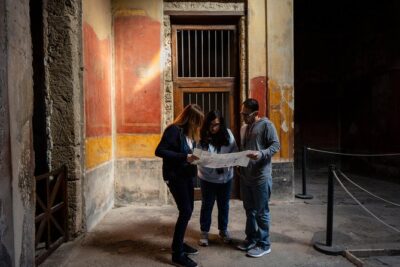
Pompeii & Mt.Vesuvius Day Tour from Naples with Pizza Lunch
Read our review →
Pompeii & Mt Vesuvius All-Inclusive Small Group w/ Lunch
Read our review →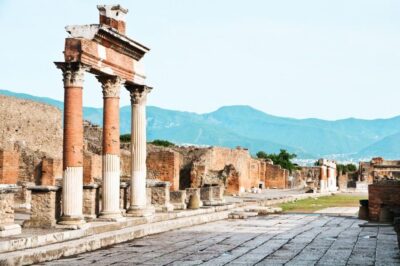


Pompeii & Amalfi Coast Full-Day Trip with Lunch
Read our review →Browse the lists this tour appears in