Reviewed · GUIDED
Naples: Ipogeo dei Cristallini Guided Tour
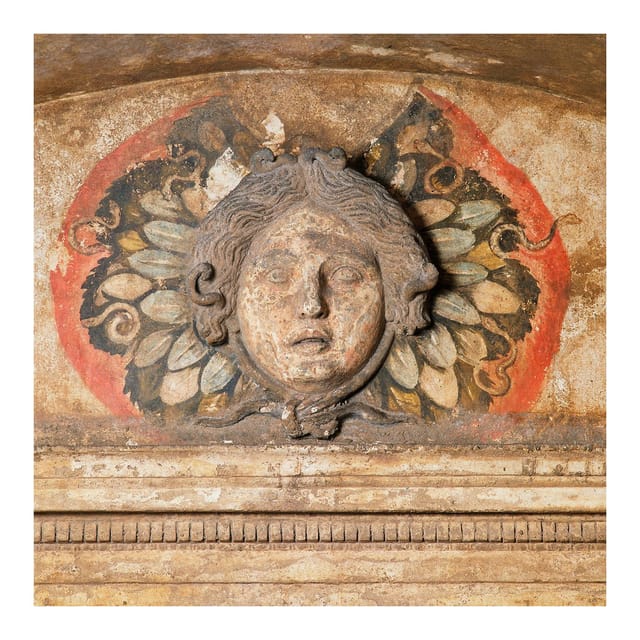
The remarkable thing here is not simply that you visit an ancient site. You walk 12 meters below modern Naples and find four Greek tombs, carved and painted about 2,400 years ago. The centerpiece is a Medusa that is both sculpted and painted, an unusually vivid survival from the 4th century BC.
I like the small groups of up to 10 and the local guide from Rione Sanità, which make a short visit feel focused rather than rushed. I also like the opening video, which gives you a clear picture of the ancient site before you reach the tombs. The main drawback is practical: the stairway is dim and can be difficult if you have bad knees or limited mobility.
In This Review
- Key points
- Why Ipogeo dei Cristallini Feels So Different
- The Video Sets the Scene Before You Go Underground
- Descending 12 Meters Into Ancient Neapolis
- Four Hellenistic Tombs and Their Painted Details
- The Medusa Is the Moment to Watch For
- Greek Origins and Roman Changes in One Place
- What the Rione Sanità Setting Adds
- Is 45 Minutes Enough?
- Is $21 a Fair Price?
- Who Should Book This Experience?
- Practical Tips Before You Go
- Should You Book Ipogeo dei Cristallini?
- FAQ
- How long does the Ipogeo dei Cristallini guided tour last?
- How far underground is Ipogeo dei Cristallini?
- What can I see inside the Ipogeo dei Cristallini?
- Is the tour available in English?
- How many people are in each tour group?
- Can children visit Ipogeo dei Cristallini?
- Is the site accessible for people with disabilities?
Key points
- Four Hellenistic tombs underground: Descend 12 meters to an ancient Greek burial site beneath Naples.
- A rare painted Medusa: See the sculpted and painted figure described as unique in the world.
- Greek and Roman art together: The tombs combine Greek origins with later Roman artistic additions.
- A short, focused visit: The guided experience lasts 45 minutes, making it easy to fit into a day in Naples.
- A local perspective: Your guide explains the site alongside the story of Rione Sanità and modern Naples.
- Mind the stairs: The underground setting has low light, steps, and architectural barriers.
Why Ipogeo dei Cristallini Feels So Different
Naples has no shortage of ancient remains, but Ipogeo dei Cristallini gives you a particularly direct encounter with the city’s Greek past. This is not a large open-air ruin with columns spread across a broad field. It is a compact underground complex where the architecture, paintings, burial customs, and later changes all sit close together.
You begin near the lively Rione Sanità neighborhood. Then the modern city gives way to a descent into the earth. At 12 meters below street level, you reach an ancient street connected to Neapolis, the Greek city that helped shape Naples.
That contrast is part of the appeal. Above you is present-day Naples, full of traffic, shops, and daily life. Below you are tombs made for the dead, decorated with scenes and symbols meant to accompany people into the next stage of existence. The experience asks you to think about death, but also about family, love, friendship, and care.
The site is small, so you will not spend hours wandering. Instead, a guide draws your attention to details you could easily miss on your own. The 45-minute format works well if you want one concentrated archaeological stop without committing half a day.
A few more Naples trips worth weighing up
- Naples: Catacombs of San Gennaro Entry Ticket & Guided Tour
★ 4.6 · 7,941 reviews - Naples: Spanish Quarters Underground Guided Tour
★ 4.8 · 5,064 reviews - Naples: Street Food Walking Tour with Local Guide
★ 4.8 · 4,256 reviews
The Video Sets the Scene Before You Go Underground
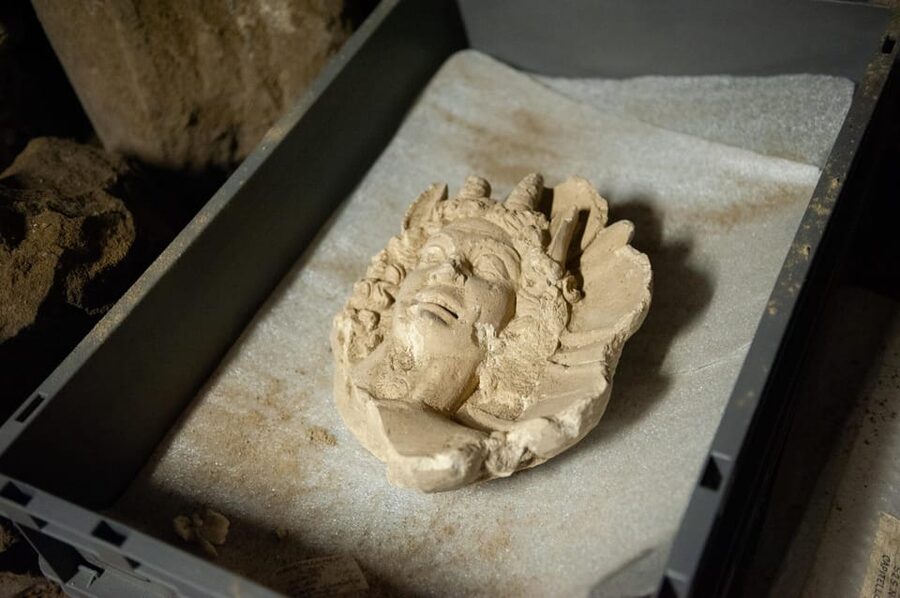
The visit begins with a video showing a virtual reconstruction of the archaeological site. This is more useful than a simple introductory film because underground tombs can be hard to read at first glance. You see the reconstructed layout before standing among the surviving walls and paintings.
I like this order. You get the broad picture first, then the physical details make more sense. The video also helps explain how the tombs relate to the original Greek street and how the site may have looked before centuries of change.
The introduction covers the discovery of Ipogeo dei Cristallini, which happened by chance in 1889 through Baron Giovanni di Donato. That detail adds a human touch. The tombs were not presented as a perfectly planned museum find. Their rediscovery came unexpectedly, after the site had remained out of everyday sight for a very long time.
Do not expect the video to replace the visit. Its value is as preparation. Once you descend, the guide can move quickly into the art, the myths, and the meaning of the architecture instead of spending the whole time explaining the basic layout.
Descending 12 Meters Into Ancient Neapolis
The physical descent is an important part of the experience. You do not simply walk through a museum doorway into a recreated room. You go down into the underground world where the tombs were carved.
The stairs are not a minor detail. The lighting is limited, and you need to watch your footing. One guide is reported to have carefully pointed out the steps, which is exactly the kind of practical help you want in a historic site. If your knees are troublesome, take your time and let the guide assist you.
The underground architecture also means this is not suitable for everyone. Children under eight cannot enter. Children from eight to 12 years old visit free, but they still need to manage the descent safely. The site has architectural barriers because of its historic structure, so anyone with a disability should contact the site before booking to discuss access.
Once you reach the tombs, the stairs are worth the effort for most people who can manage them. The setting gives the ancient art a strong sense of place. These are not detached objects in a display case. They remain connected to the chambers and stonework for which they were made.
Four Hellenistic Tombs and Their Painted Details
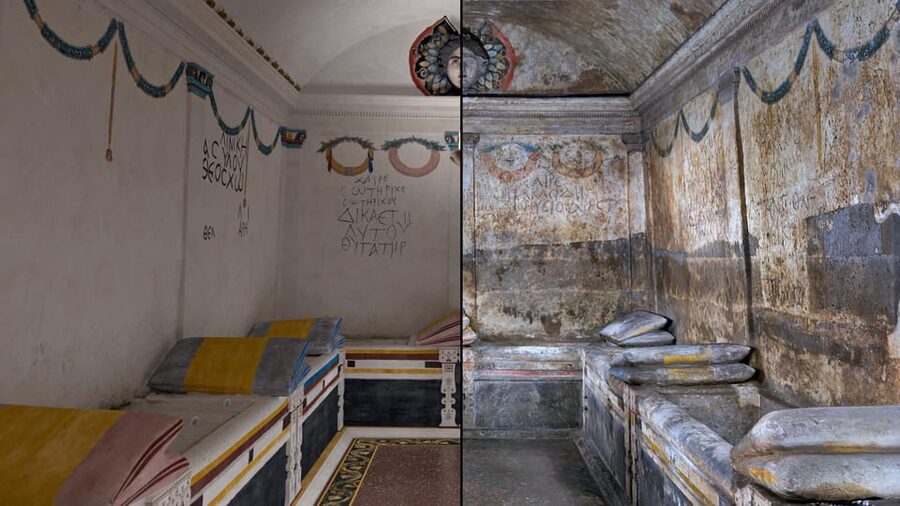
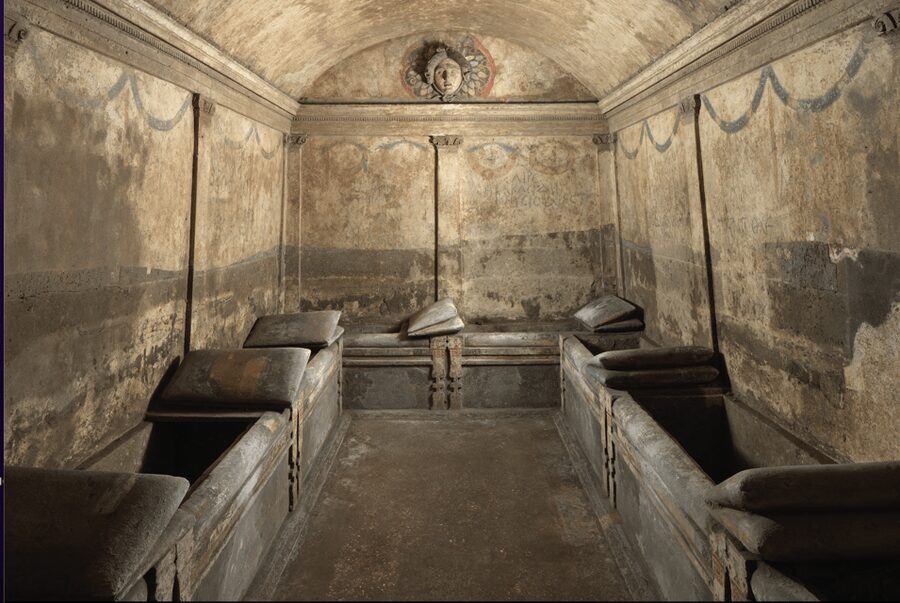
The core of the visit is the group of four Hellenistic tombs. They were carved and painted by the ancient Greeks in the 4th century BC, making them an unusually important record of Greek art in Naples.
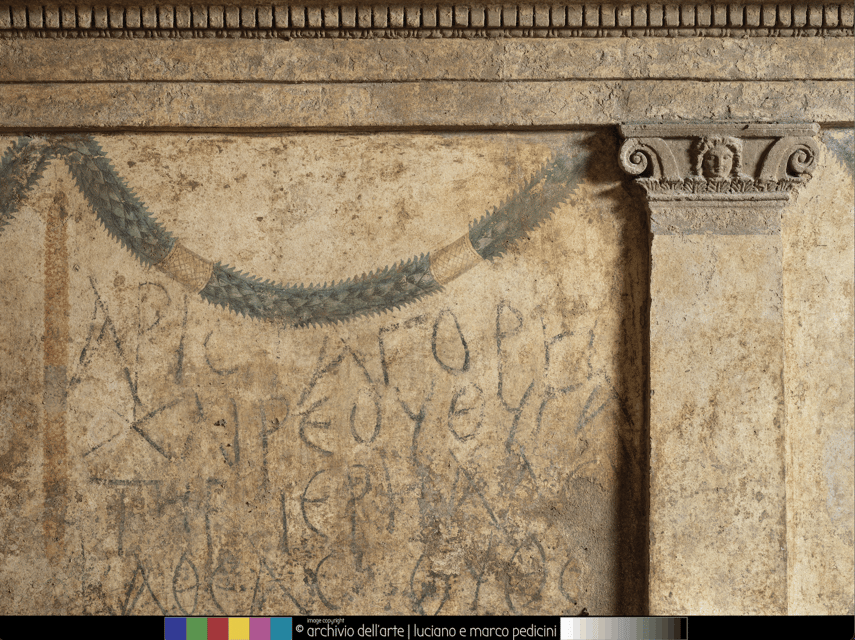
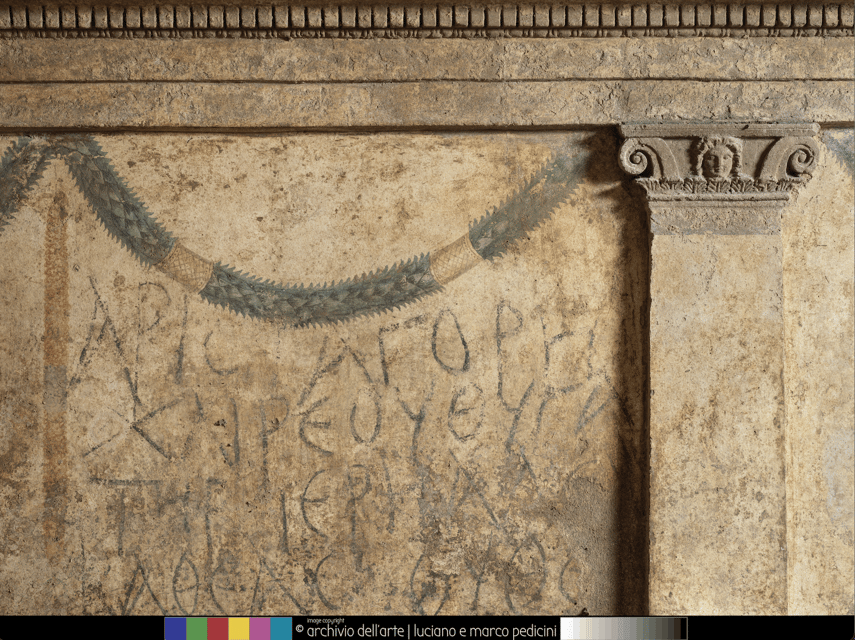
The tombs show that ancient burial spaces were not necessarily bare or gloomy. Color played a major part. The surviving polychromy, meaning the use of several colors, helps you picture an ancient world that is often wrongly imagined as plain white stone.
Some color has naturally been lost over time, but what remains is enough to change the way you see the architecture. Painted surfaces give shape and feeling to the carved details. Your guide explains the myths and the artistic choices, helping you connect a decorative feature with the wider beliefs of the people who built the tombs.
This is where the small group matters. With no more than 10 people, you have a better chance of hearing the explanation and seeing the features the guide is pointing out. The chambers are small, so a large crowd would make the visit less comfortable and would make it harder to appreciate the paintings.
The site also shows a meeting of cultures. The tombs have Greek origins, but Roman artistic additions later became part of the complex. Rather than presenting Greek and Roman influence as two separate chapters, the visit shows how ancient Naples changed over time and absorbed new artistic ideas.
A completely different sort of day out of Naples:
- From Naples: Pompeii Ruins & Mount Vesuvius Day Tour
★ 4.3 · 11,459 reviews - From Naples: Sorrento, Positano and Amalfi Full-Day Tour
★ 4.6 · 10,988 reviews - From Naples: Sorrento, Positano & Amalfi Coast – Small Group Tour
★ 5.0 · 8,643 reviews - Naples: Downtown Tour with Veiled Christ & St Clare Tickets
★ 4.9 · 6,462 reviews
The Medusa Is the Moment to Watch For
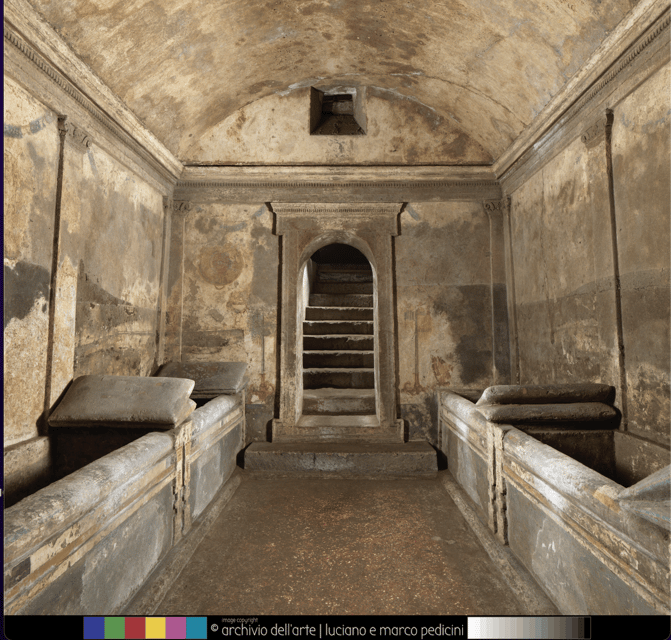
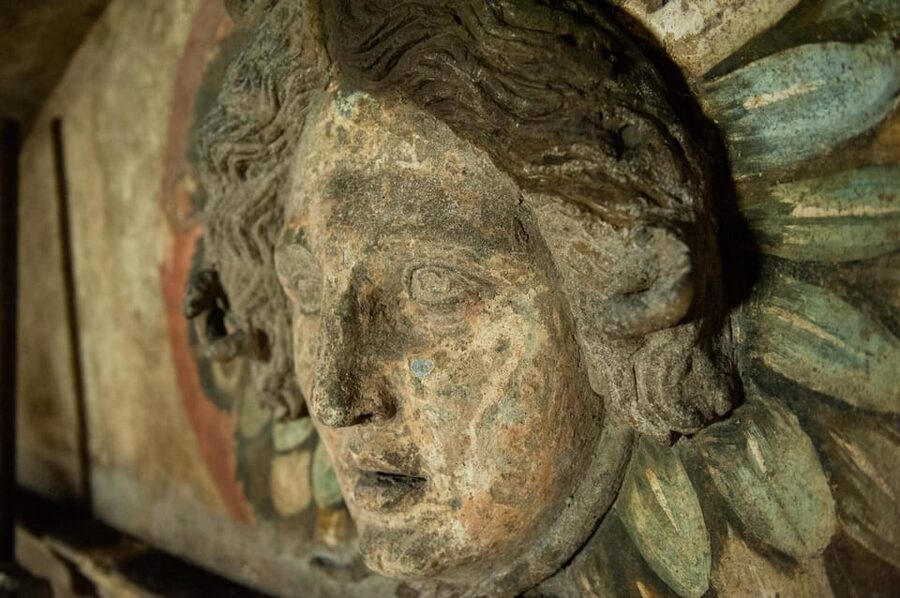
The most memorable feature is the Medusa. Here, the figure is both sculpted and painted, making it far more than a flat image on a wall.
Medusa belongs to Greek mythology and is instantly recognizable, but seeing her in this setting gives the figure a different force. The artwork was created for a tomb, not as a modern art object. Its place within the burial architecture matters as much as its appearance.
The painted color is especially important. Ancient art is often reduced to white marble in popular images, yet this Medusa reminds you that Greek artists used color and surface detail to give their work power. The combination of sculpture and paint makes the piece unusual, and the site presents it as a unique example in the world.
Your guide explains the myths connected with the tombs and the Medusa. That context keeps the visit from becoming a quick look at attractive fragments. You gain a better sense of why such images mattered and how art could protect, honor, or accompany the dead.
If you remember only one feature afterward, it will probably be this one. The chamber is small, the figure is ancient, and the surviving color creates an immediate link to the people who stood before it more than two millennia ago.
Greek Origins and Roman Changes in One Place
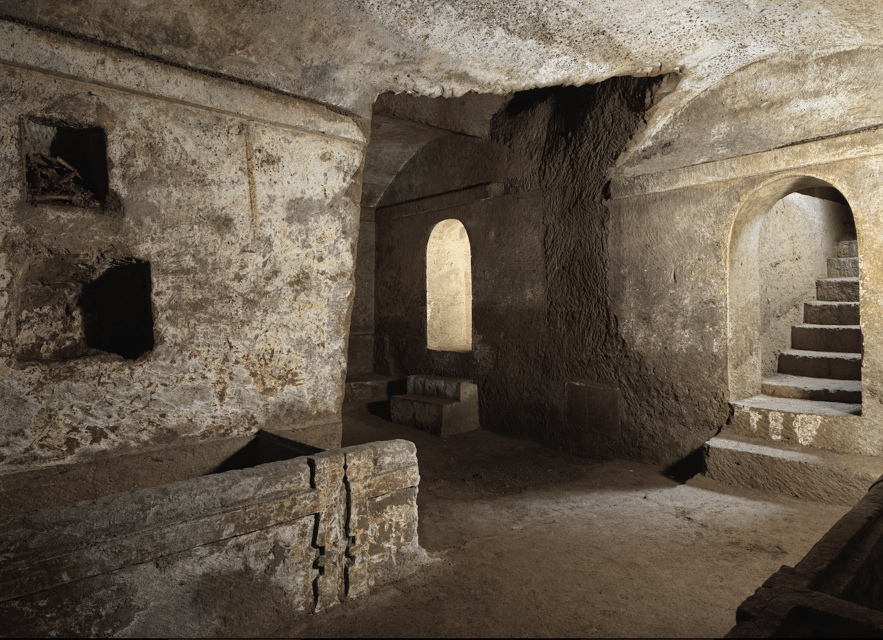
Ipogeo dei Cristallini is valuable because it does not present Naples as belonging to one culture alone. The original tombs are Greek, while Roman additions show that the site continued to develop after the Greek period.
That blend reflects the long life of Naples itself. Cities change hands, adopt new customs, and reuse older spaces. Here, those changes are visible in the architecture and decoration rather than only in a history book.
I like that the guide explains this as a meeting of artistic traditions. You are not asked to memorize a long list of dates. Instead, you can see how different periods left their mark on one compact site.
The tombs also offer a personal side of ancient life. The guide connects the artwork with ideas of family, friendship, love, and care. That makes the visit more approachable. You are not looking only at burial chambers from a distant civilization. You are seeing how people tried to express relationships and respect for the dead.
What the Rione Sanità Setting Adds
The site’s location in Rione Sanità gives the tour a wider frame. The guide does more than explain the underground rooms. You also hear about the neighborhood and its powerful story within Naples.
That matters because the Ipogeo is not isolated from the city above. Its meaning is tied to the area around it, and a local guide can connect the archaeological site with the character and past of Rione Sanità.
The neighborhood is a strong match for the experience. It helps you see Naples as a city built in layers, with ancient Greek foundations beneath later streets and buildings. The underground tombs are one part of a much larger story.
I would pair this visit with time to explore Rione Sanità on foot, but I would not claim that the 45-minute tour itself provides a full neighborhood tour. The supplied experience focuses on the Ipogeo, the ancient art, the myths, and the history of Naples. The neighborhood context adds depth, but the tombs remain the main event.
Is 45 Minutes Enough?
For this site, yes, provided you know what you are booking. Forty-five minutes is enough for the video, the descent, an explanation of the four tombs, close attention to the paintings and Medusa, and a discussion of the Greek and Roman layers.
It is not enough for a slow, independent archaeological study. You will follow the guide’s route and listen as the details are explained. If you want to examine every painted surface at length, the short format may leave you wishing for more time.
I see the limited duration as an advantage for a busy Naples schedule. You can place it between other visits without giving up a large part of the day. The small group also helps the visit feel substantial despite its length.
The guide languages are Italian, English, French, and Spanish. Make sure you choose the language that lets you follow the myths and historical explanations easily. The art is striking on its own, but the story behind it is a major part of the value.
Is $21 a Fair Price?
At $21 per person, this is a reasonable price for a live, small-group archaeological visit to a highly unusual site. You are paying for access to a protected underground complex, a guide, the opening video, and a focused explanation of art that would be difficult to understand fully without help.
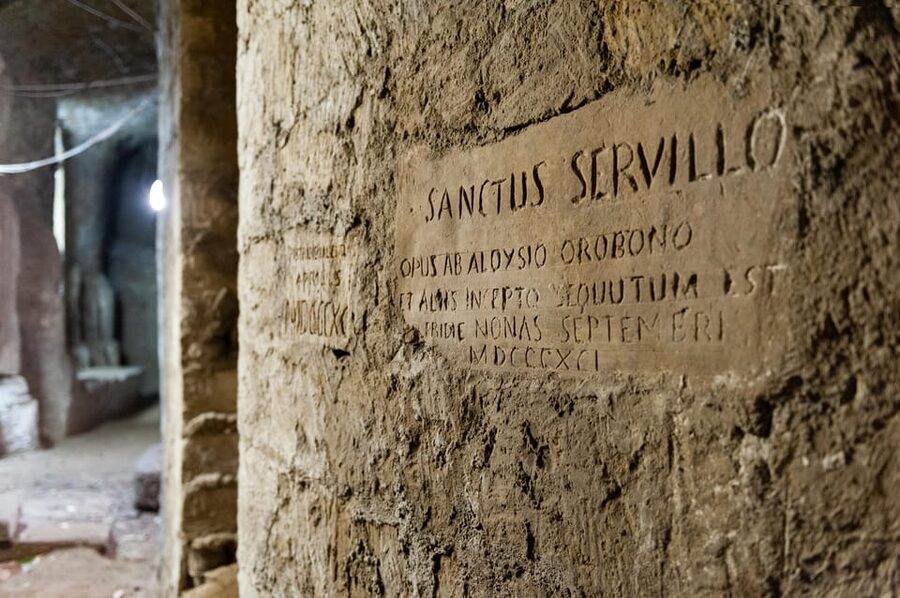
The price is especially fair if you value interpretation. The tombs are compact, and you could look at them quickly on your own if independent access were available. The guide gives you the key context: the Greek origins, the Roman additions, the 1889 discovery, the myths, and the meaning of the painted decoration.
The value is less obvious if you want a long, leisurely museum visit. This is a short experience with a specific focus. You are paying for quality of access and explanation, not for hours inside a large archaeological park.
Free cancellation up to 24 hours before the visit and the option to reserve without paying immediately make the booking less rigid. Those terms are useful in Naples, where plans can change quickly. Still, the most important question is not flexibility. It is whether you are comfortable with stairs and a small underground space.
Who Should Book This Experience?
I would recommend it to you if you enjoy archaeology, ancient art, mythology, or unusual places that reveal a less obvious side of Naples. It suits adults and children aged eight and over who can manage the stairs.
It is also a good choice for anyone who has already seen the city’s better-known sights and wants something more focused. The Greek foundations of Naples are easy to overlook while moving between churches, markets, and museums. This visit puts those foundations at the center.
Families should consider the age rule and the dim stairway. Older children with an interest in myths may find Medusa and the tomb paintings memorable, while very young children cannot enter.
You should think carefully if you have bad knees, balance problems, or reduced mobility. A kind guide may offer help, but the site itself has historic barriers, and assistance cannot remove every physical challenge. Contact the site before your visit so access can be discussed honestly.
Practical Tips Before You Go
Set aside a little extra care for the descent. Wear shoes that feel secure on stairs, watch each step, and do not rush because the lighting is low.
Keep your expectations focused. This is not a large complex with many rooms to roam through. The chambers are small, and the experience works best when you pay close attention to the guide’s explanation.
If you like taking notes or photographs, check the instructions you receive on site. The supplied information confirms the visit includes a video and guided explanation, but it does not specify a photography policy.
Choose your language carefully. Italian, English, French, and Spanish are available, and the guide’s ability to explain the myths and artwork will shape how much you take away.
The visit is limited to 10 participants. That is a useful number for a confined archaeological space, since a smaller group makes it easier to stay close to the guide without crowding the tombs.
Should You Book Ipogeo dei Cristallini?
Book it if you want a short but meaningful look at ancient Naples, especially if Greek art, painted archaeology, and mythology appeal to you. The rare Medusa, the surviving color, and the combination of Greek and Roman work give the visit a clear identity.
I would skip it only if stairs, low light, or underground spaces are likely to make the experience uncomfortable. For everyone else, $21 is a sensible price for a carefully guided 45-minute visit to an archaeological site you cannot understand fully from the street above.
FAQ
How long does the Ipogeo dei Cristallini guided tour last?
The guided visit lasts 45 minutes.
How far underground is Ipogeo dei Cristallini?
You descend 12 meters below ground to reach the archaeological site.
What can I see inside the Ipogeo dei Cristallini?
You can see four Hellenistic tombs carved and painted by the ancient Greeks, surviving frescoes, ancient architectural details, Roman artistic additions, and a Medusa that is both sculpted and painted.
Is the tour available in English?
Yes. Live guides are available in Italian, English, French, and Spanish.
How many people are in each tour group?
The group is limited to 10 participants.
Can children visit Ipogeo dei Cristallini?
Children from eight to 12 years old can visit free. Children under eight are not permitted to enter.
Is the site accessible for people with disabilities?
The site has architectural barriers because of its historic nature. Visitors with disabilities should contact Ipogeo dei Cristallini before the visit to discuss whether access is possible.
Just added around Naples
- Full-Day Tour of the Amalfi Coast and Pompeii from Naples★ 4.5 · 3 reviews
- The Ultimate Neapolitan Cooking Class with Local★ 5.0 · 3 reviews
- Naples: Old City Center Street Food Tour with Spritz★ 4.7 · 3 reviews
- Visit in Pompeii – Naples Private Tour with Ada★ 5.0 · 3 reviews
- Transfer from Naples to Sorrento or viceversa★ 5.0 · 3 reviews
- Naples: National Gallery of Capodimonte Tour★ 5.0 · 3 reviews
- Visit 2 wine producers with tasting and transportation included★ 5.0 · 3 reviews
- Naples: Mozzarella experience★ 5.0 · 3 reviews
Guided, compared.
Catacombs of San Gennaro Entry Ticket & Guided Tour
Read our review →


Mount Vesuvius: Skip-the-Line Ticket and Smart Digital Guide
Read our review →
The Bourbon Tunnel Guided Tour with Entrance Ticket
Read our review →
Authentic Naples Street Food Tour With Local Expert Guide
Read our review →