
Reviewed · HERCULANEUM TOURS
Herculaneum: Skip-the-Line Guided Tour with Archaeologist
Herculaneum gives you something Pompeii cannot: an unusually close look at Roman homes, shops, woodwork, mosaics, and painted rooms preserved by the eruption of Vesuvius. The waterfront boathouses are especially sobering, with the remains of more than 300 people who tried to flee by sea.
I like the archaeologist guide, who can explain not only what you are seeing but why it survived. I also like the skip-the-line entry and the fact that your admission lets you stay after the two-hour tour to explore on your own. The main drawback is pace: two hours covers a lot, and groups of 16 to 20 can make it harder to hear or keep up.
- A different experience from Pompeii: Herculaneum is smaller, quieter, and better preserved in many places.
- Archaeology with a human voice: Guides such as Luciano Leone, Diego, Teresa, and Angelo use stories, photos, and comparisons to explain the site.
- The most striking remains: See carbonized wood, painted walls, mosaics, ceramics, marble, and the House of Neptune and Amphitrite.
- Skip the ticket line: Meet at the ruins’ ticket office, where your guide holds an Askos Tours sign.
- A demanding two-hour walk: Expect exposed sun, uneven stone, and no suitable access for wheelchair users or people with mobility impairments.
- Good value for a focused visit: At $53, admission and a specialist guide are included, but transport, food, and drinks are not.
In This Review
- Why Herculaneum Feels So Different From Pompeii
- Meeting at the Via dei Papiri Ercolanesi Entrance
- The Waterfront and the Human Cost of the Eruption
- Casa dei Cervi and Herculaneum’s Wealthy Homes
- House of Neptune and Amphitrite’s Brilliant Mosaic
- The House of Skeletons and the Buildings Around It
- Thermal Baths, the Forum, and Everyday Roman Life
- The Temple of the Augustales and the Gymnasium
- What the Archaeologist Guide Adds
- Is $53 a Fair Price?
- Practical Tips for a Better Visit
- Who Should Book This Herculaneum Tour?
- FAQ
- Where does the Herculaneum tour meet?
- How long is the guided tour?
- Is admission to Herculaneum included?
- Which languages are available?
- Is transportation from Naples included?
- What should I bring, and are there restrictions?
- Should You Book It?
Why Herculaneum Feels So Different From Pompeii

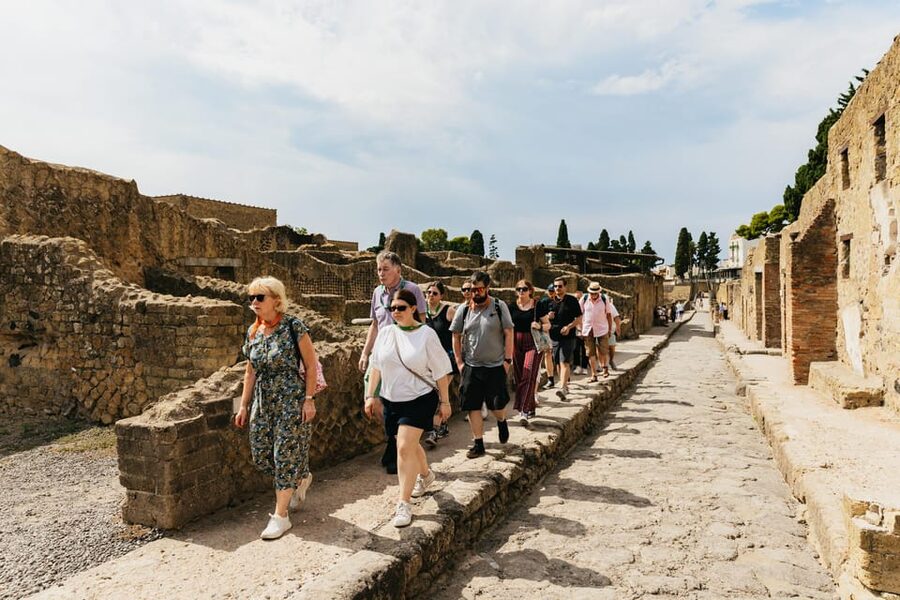
Pompeii is famous for its broad streets and huge scale. Herculaneum offers a tighter, more intimate look at Roman life. The town was a former port, home to wealthy merchants and noble families, and its houses often preserve details that make the past feel surprisingly close.
The eruption did not treat both towns in the same way. Herculaneum was covered by a fast-moving mass of hot mud and volcanic material, which buried buildings to a great depth. That helped preserve carbonized beams, doors, furniture fragments, painted walls, and household objects that are less common at Pompeii.
Your guide will help you read those remains. A wall is no longer just a wall when you understand the room it belonged to, the people who used it, and the sudden event that sealed it away. Guides including Luciano Leone have used books, photographs, and before-and-after images to show what the town may have looked like before the eruption.
That visual help matters. Without it, Herculaneum can seem like a maze of stone rooms. With it, you begin to picture a working town with merchants, families, religious groups, bathers, and people moving between houses and public buildings.
Meeting at the Via dei Papiri Ercolanesi Entrance
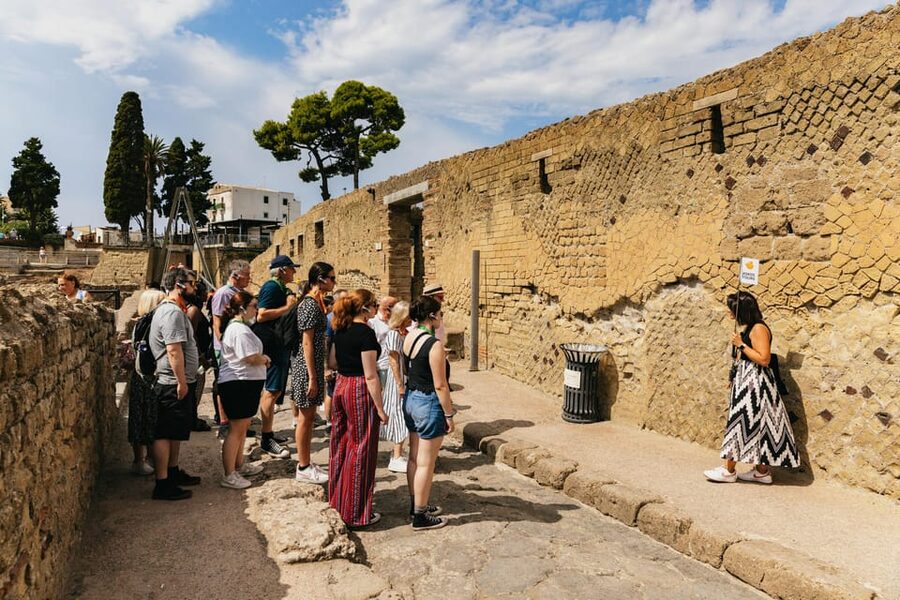
The meeting point is the ticket office at the Herculaneum ruins on Via dei Papiri Ercolanesi. Look for the guide holding an Askos Tours sign.
Allow extra time to find the entrance. One booking map marker has reportedly appeared about 300 meters away from the actual meeting point, so the ticket office is the useful landmark, not a restaurant or a pin farther down the street. Bring your passport or ID card, as valid identification is required.
The tour includes your Herculaneum admission, headsets, and the live guide. The headset is important because the guide may move ahead through narrow streets and courtyards. Stay close enough to keep the audio clear, especially if your group is near the larger end of the usual range.
The tour runs in English, Italian, German, Spanish, and French. Transportation from Naples is not included, so you must arrange your own way to the archaeological site.
More Herculaneum visits from Naples:
- Herculaneum Small Group Tour and Ticket With an Archaeologist
★ 5.0 · 994 reviews - Herculaneum: Skip-the-Line Entry Ticket with Audio Guide
★ 4.3 · 870 reviews - From Naples: Pompeii & Herculaneum with Archaeologist Guide
★ 4.8 · 665 reviews
The Waterfront and the Human Cost of the Eruption
The waterfront is one of the most powerful parts of the visit. It is not a cheerful introduction, but it explains the speed and force of the disaster better than almost anything else at the site.
More than 300 people died while trying to escape toward the sea. Their remains lie in the old boathouse area, where the town once met the water. You can see how the shore was part of ordinary life, then consider how quickly it became a place of panic.
A good guide handles this area with care. The point is not spectacle. It is to understand the final moments of a town whose people had little time to react.
This stop also gives the rest of the visit more weight. The homes and public buildings are not empty ruins in an abstract sense. They belonged to real families and workers who lived through a disaster that changed the region forever.
Casa dei Cervi and Herculaneum’s Wealthy Homes
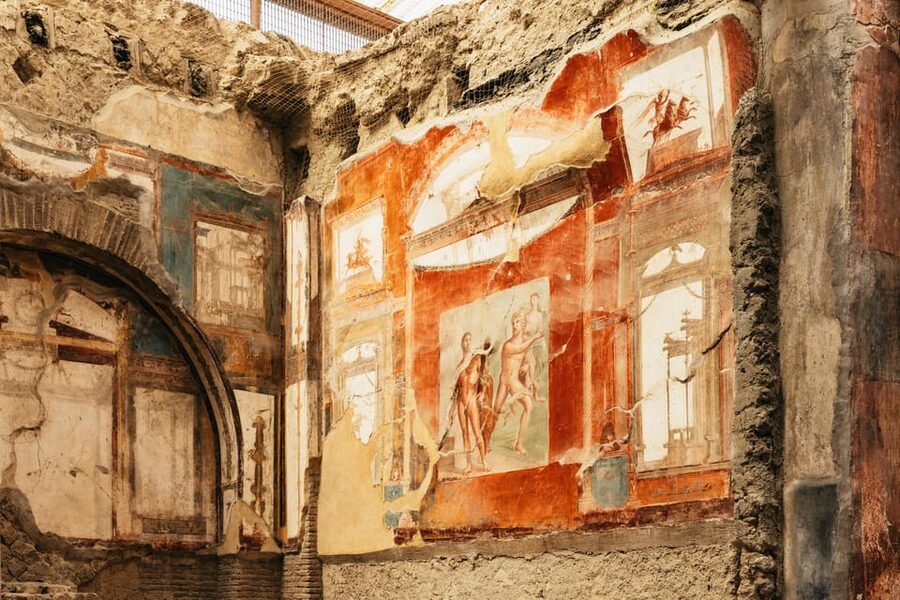
Casa dei Cervi, or the House of the Deer, is one of the villas that helps explain Herculaneum’s connection to wealth and status. The name comes from deer sculptures found at the house.
Here, your guide can point out how a large Roman home was arranged around open spaces and views. Marble decoration, wall paintings, and carefully planned rooms show that this was not a simple working-class dwelling. Herculaneum’s homes reveal a town where prosperous residents invested in comfort, decoration, and entertainment.
The challenge is that a two-hour route cannot give every room equal time. You will get the essential story and the most important features, but if you enjoy architectural details, plan to remain after the guided portion and look again at a slower pace.
That extra time is one of the tour’s best practical benefits. Your ticket is valid for the day, so the guided walk can give you a strong framework before you return to your favorite houses alone.
House of Neptune and Amphitrite’s Brilliant Mosaic
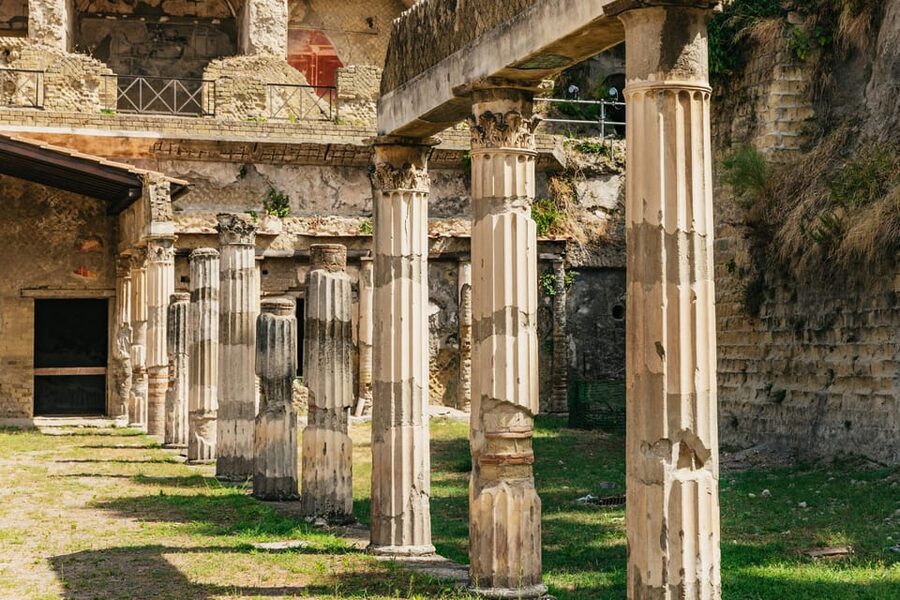
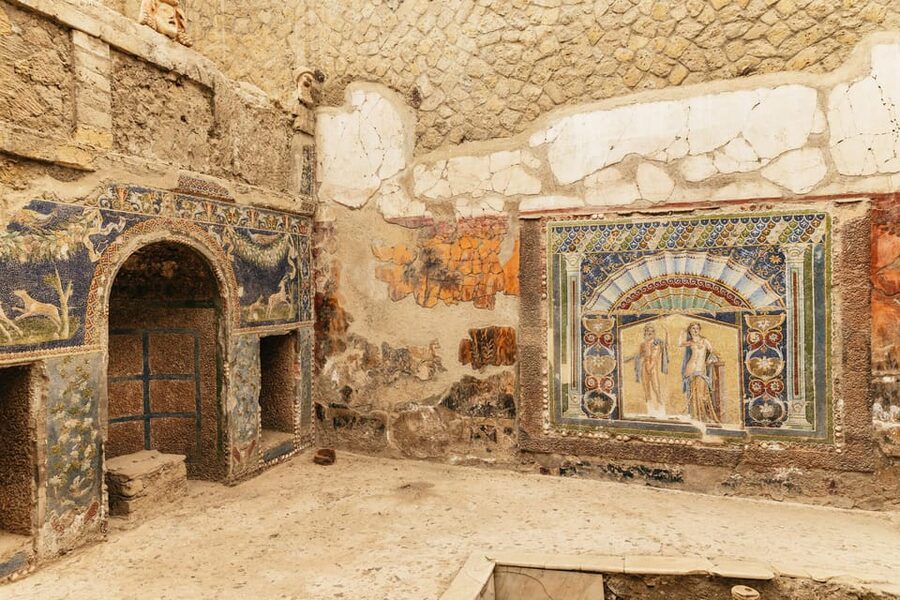
Casa di Nettuno ed Anfitrite is one of the visual highlights. The House of Neptune and Amphitrite contains a famous mosaic wall in bright glass paste, with marine imagery associated with Neptune and Amphitrite.
The decoration is easy to admire, but the guide adds the useful question: what did such a display say about the owner? Roman houses communicated status through color, imported materials, mythological scenes, and the careful placement of decoration where guests would notice it.
This is also where the quality of Herculaneum’s preservation becomes clear. You are not only seeing foundations. You may see color, pattern, plaster, stone, and small details that make the rooms readable.
The house can attract attention because it is one of the site’s best-known stops. Listen through the headset and position yourself where you can see the guide’s chosen feature. In a group of 16 to 20, it may take a moment to get a clear view.
A few more Naples trips worth weighing up
- Mount Vesuvius: Skip-the-Line Ticket and Smart Digital Guide
★ 4.2 · 2,780 reviews - From Naples: Pompeii Skip-the-Line Entry Ticket and Tour
★ 4.4 · 2,753 reviews - Pompeii: Skip-the-Line Entry Ticket with Audio Guide or Tour
★ 4.1 · 1,364 reviews - From Naples: Pompeii Guided Tour with Skip-the-Line Tickets
★ 4.8 · 1,171 reviews
The House of Skeletons and the Buildings Around It
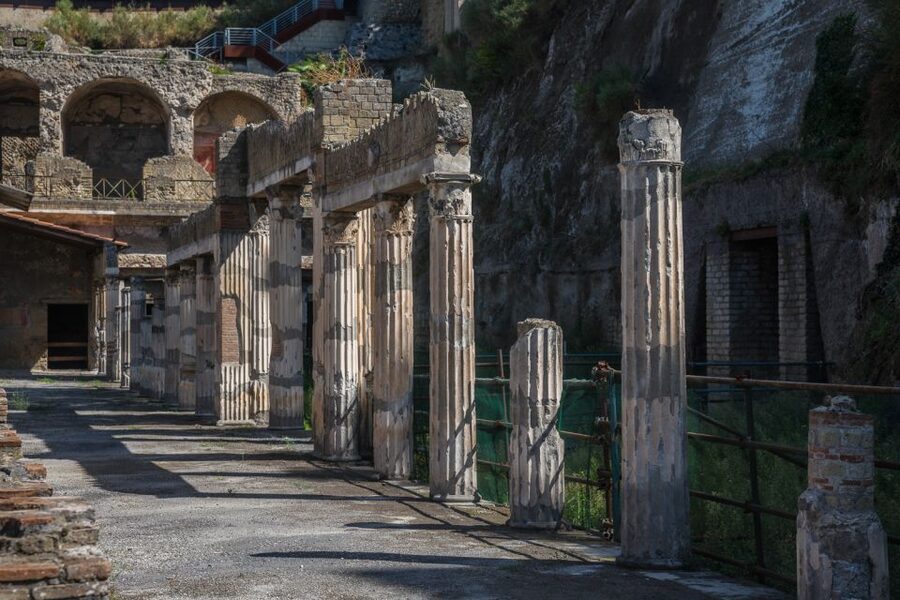
The House of Skeletons carries an unsettling name connected with human remains found during excavation. It is another reminder that Herculaneum was not simply abandoned. Its residents were caught in a catastrophe that arrived with terrible speed.
From here, the tour continues through several houses and public spaces. Casa dell’Albergo, or the House of the Inn, and Casa del Salone Nero, the House of the Black Room, show different approaches to domestic space and decoration.
The names are helpful landmarks, but do not expect every building to look complete. Some rooms are open to the sky, some are partly restored, and access can change. Your archaeologist guide helps you separate original evidence from modern protection and reconstruction.
The House of the Black Room is useful for understanding painted interiors. Dark walls and decorative schemes could create a strong visual effect in a room lit by daylight, lamps, or doors opening onto a courtyard. This is the kind of detail that can be missed when you walk alone without context.
Thermal Baths, the Forum, and Everyday Roman Life
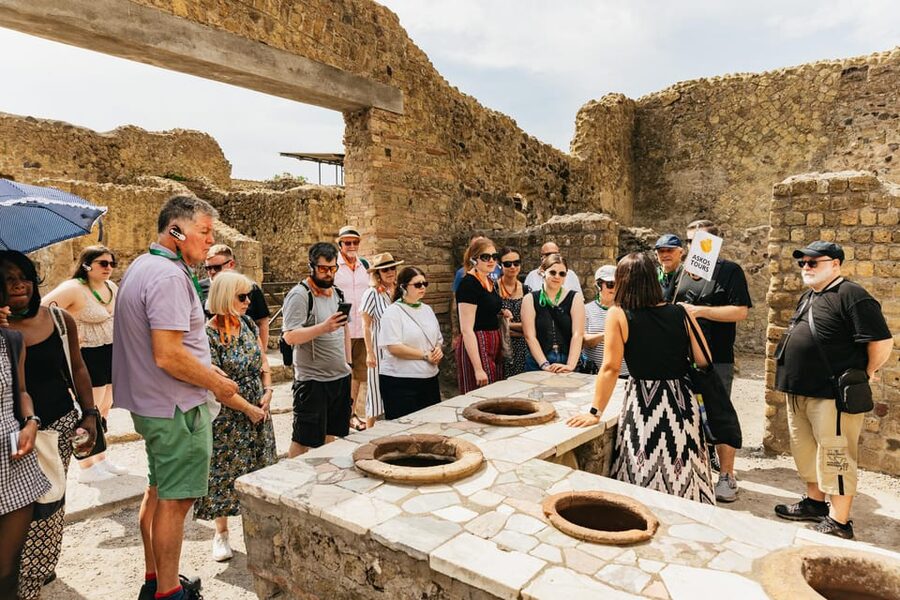
The thermal baths reveal the ordinary rhythm of the town. Romans did not treat bathing as a quick wash at home. Public baths were places for exercise, conversation, grooming, and social contact.
Look for the practical engineering: changing areas, decorated rooms, floors, and systems designed to move hot air or water through the complex. The remains may not always be immediately obvious, but the guide can show you how the spaces worked.
The Forum was the civic heart of Herculaneum. It connected public, religious, and commercial life. Compared with a private house, it shifts your attention from family status to the wider town.
This contrast is one reason I recommend the guided format. You move from a wealthy villa to a bath complex, then to a civic space and religious building. The route becomes a lesson in how the town functioned, not just a parade of attractive ruins.
The Temple of the Augustales and the Gymnasium
The Sacellum of the Augustales, also called the Temple of the Augustales, was linked with the worship of the emperor and the civic identity of the town. Its painted decoration and compact design offer a glimpse into the religious and political life of Roman Herculaneum.
The building is especially useful for understanding how religion and public loyalty overlapped. The Romans did not separate private belief, civic duty, and imperial authority in the same way modern visitors might.
The Gymnasium adds another layer. It was a large public complex, and the tour may include a view into a central area where a swimming pool would have been. One guide has taken groups into a tunnel toward the center, offering a more unusual look at the structure.
Access through parts of the site can be uneven or restricted, so follow the guide’s instructions. This is not a museum with smooth floors and wide corridors. Closed-toe shoes make a real difference.
What the Archaeologist Guide Adds
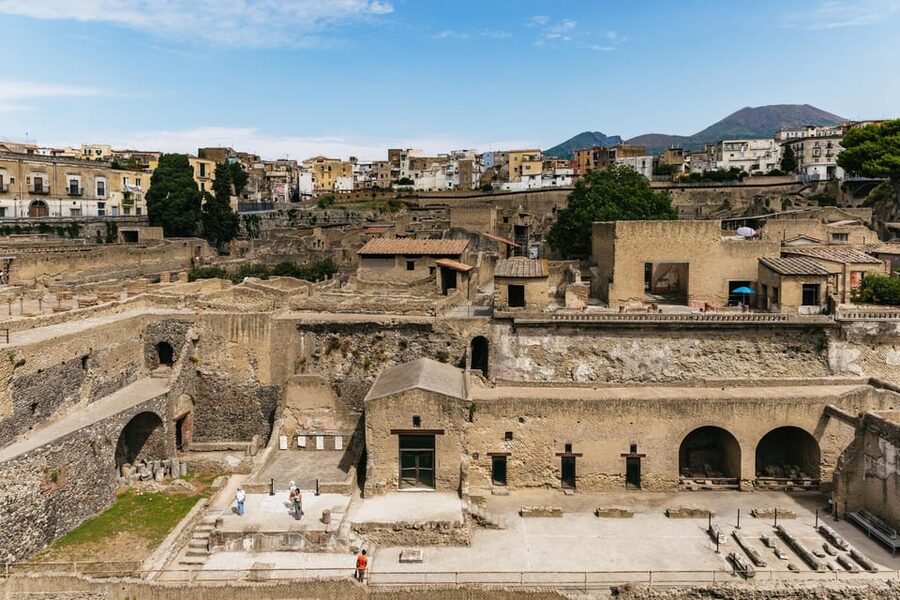
The strongest part of this experience is the guide. The tour has featured archaeologists and guides including Luciano Leone, Diego, Teresa, Angelo, Anna, Roberta, Y olanta, Giovanni, Bruno, and Gerardo. The exact guide depends on the date and language you choose.
Luciano Leone receives especially strong praise for his energy, humor, visual aids, and clear explanations. He has used personal books and photographs to compare Herculaneum before and after the eruption. Angelo has also brought binders and images with overlays that help reconstruct the buried town.
The best guides do more than recite dates. They explain how Roman houses worked, why wood survived here, how the eruption differed from Pompeii, and what archaeologists can and cannot know. They also answer questions, which is valuable when a particular room or object catches your attention.
The style can be lively. That helps families and first-time visitors, though a fast, enthusiastic guide may occasionally move beyond the headset’s clearest range. If you cannot hear, say so at once. Do not wait until the next building.
Some children will enjoy the dramatic eruption story and the preserved objects. Others may tire during a detailed explanation of architecture. An eight-year-old has enjoyed this tour with a guide who kept the material accessible, but an 11-year-old who had already visited Pompeii became bored. Your child’s interest in ancient history matters more than the age label.
Is $53 a Fair Price?
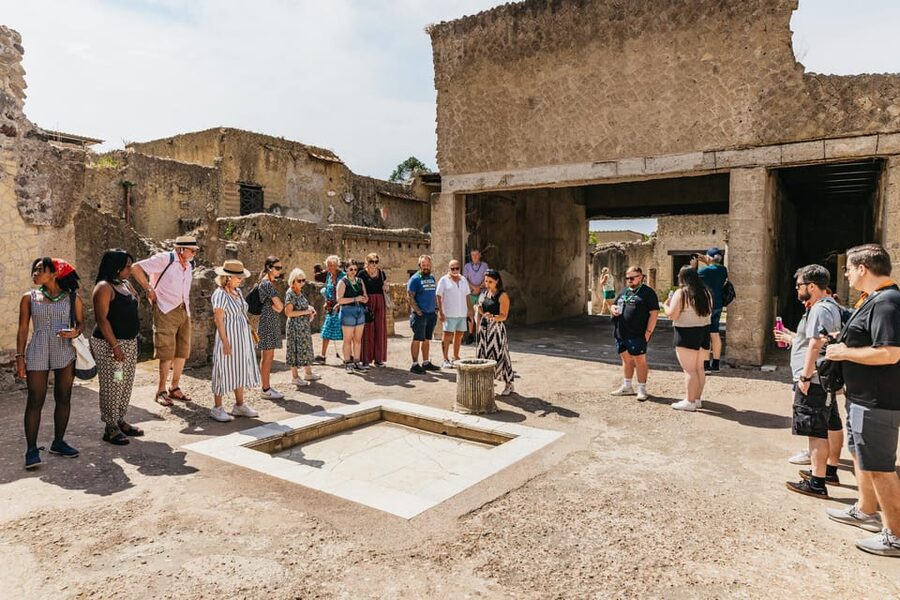
The listed price is $53 per person. That includes the archaeological site admission, a two-hour guided tour, an archaeologist guide, and headsets. Transportation, food, and drinks are separate.
For comparison, standard adult admission to Herculaneum is listed as 16 euros, with a 2 euro rate for EU citizens aged 18 to 25. That means much of the tour price pays for the guide, organization, skip-the-line access, and interpretation.
I consider it fair if you want to understand the site rather than simply walk through it. The archaeology is layered and the buildings are not always self-explanatory. A good guide can save you from missing the details that make Herculaneum special.
The value improves if you use the included admission for the rest of the day. The guided portion takes two hours, but you can stay afterward and revisit houses, museums, or areas you want to see more quietly.
The price is less attractive if you prefer to read signs, move slowly, or photograph every room without a group. In that case, buy a standard ticket and explore independently. You will lose the specialist commentary, but gain full control of your time.
Practical Tips for a Better Visit
Herculaneum is exposed and can be hot. Wear sunscreen and bring a hat. The tour operates in rain or shine, so pack a raincoat if the forecast is uncertain.
Choose closed-toe, comfortable shoes. The ancient paving is uneven, and open sandals are a poor match for the ruins. Large bags and luggage are not allowed, so arrange storage before arriving if necessary.
A morning time slot may be better if you want to continue exploring alone afterward. One late afternoon tour ended close to the site’s closing time, leaving no chance for a quiet second walk. Check the available starting times before booking.
Group size can vary. Groups around 15 people are manageable, while groups of 16 to 20 may feel less personal. Headsets help, but the guide’s position still matters in narrow streets and crowded rooms.
The site is not suitable for wheelchair users or people with mobility impairments. Children must be accompanied by an adult, and unaccompanied minors are not accepted.
You can cancel up to 24 hours before the tour for a full refund, and the reserve-now, pay-later option keeps your plans flexible.
Who Should Book This Herculaneum Tour?
I would choose this tour if you are visiting Herculaneum for the first time, especially after seeing Pompeii. The comparison makes sense of both sites, and several guides make a point of explaining how the two eruptions affected them differently.
It also suits anyone interested in Roman domestic life. Herculaneum’s preserved wood, mosaics, ceramics, paintings, and household spaces reward close attention. The guide helps turn those fragments into a picture of daily life.
Families can do well here if children enjoy stories, disasters, and ancient buildings. The two-hour length is manageable, but the level of detail may be too much for children who are already tired from Pompeii.
I would be more cautious if you have trouble walking, dislike uneven surfaces, or want a completely private visit. The site is exposed, the pace is set by the group, and some explanations can be dense.
FAQ
Where does the Herculaneum tour meet?
Meet at the ticket office of the Herculaneum ruins on Via dei Papiri Ercolanesi. Your guide will hold an Askos Tours sign.
How long is the guided tour?
The guided visit lasts two hours. Starting times vary, so check availability when booking.
Is admission to Herculaneum included?
Yes. The tour includes admission to the archaeological site. Standard adult entry is listed as 16 euros, with a 2 euro rate for EU citizens aged 18 to 25.
Which languages are available?
The live tour is available in English, Italian, German, Spanish, and French.
Is transportation from Naples included?
No. Transportation, food, and drinks are not included. You must arrange your own transport to the Herculaneum meeting point.
What should I bring, and are there restrictions?
Bring a valid passport or ID card, comfortable closed-toe shoes, sunscreen, and a hat. Take a raincoat if needed because the tour runs in all weather. Luggage and large bags are not allowed.
Should You Book It?
Book this tour if you want Herculaneum to make sense, not just look impressive. The archaeologist guide, skip-the-line entry, headsets, and included admission create a useful package at $53, especially if you stay afterward to explore alone.
The best reason to book is the quality of interpretation. Guides such as Luciano Leone, Diego, Teresa, and Angelo have brought the eruption, houses, baths, and public buildings into clear focus with humor, photos, and strong subject knowledge. Just allow extra time to find the ticket office, wear sturdy shoes, and choose an earlier slot if you want time for a second look.
Just added around Naples
- Full-Day Tour of the Amalfi Coast and Pompeii from Naples★ 4.5 · 3 reviews
- The Ultimate Neapolitan Cooking Class with Local★ 5.0 · 3 reviews
- Transfer from Naples to Sorrento or viceversa★ 5.0 · 3 reviews
- Naples: Old City Center Street Food Tour with Spritz★ 4.7 · 3 reviews
- Visit in Pompeii – Naples Private Tour with Ada★ 5.0 · 3 reviews
- Naples: National Gallery of Capodimonte Tour★ 5.0 · 3 reviews
- Visit 2 wine producers with tasting and transportation included★ 5.0 · 3 reviews
- Naples: Mozzarella experience★ 5.0 · 3 reviews
Herculaneum Tours, compared.
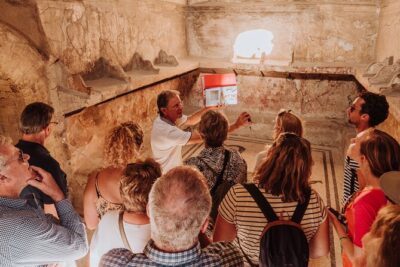
Herculaneum Small Group Tour and Ticket With an Archaeologist
Read our review →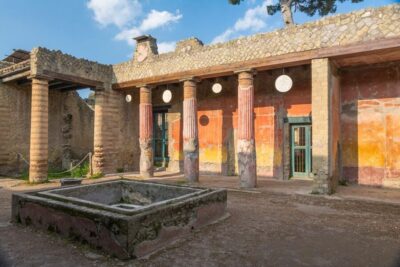
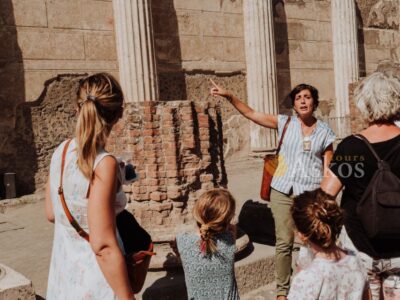
Pompeii & Herculaneum with Archaeologist Guide
Read our review →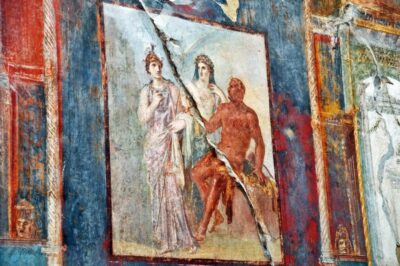
Pompeii, Herculaneum, & Vesuvius Full-Day Tour
Read our review →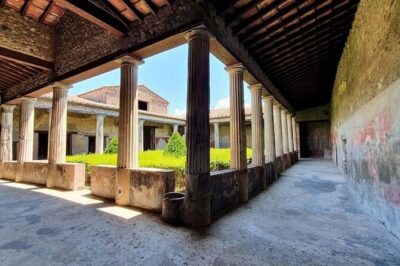
Day Trip of Pompeii, Herculaneum and Vesuvius from Naples
Read our review →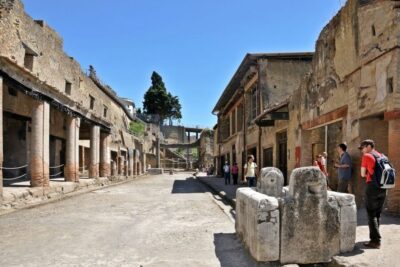
Pompeii & Herculaneum Day Trip from Naples with Lunch
Read our review →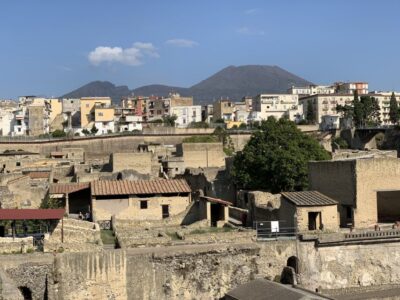
Browse the lists this tour appears in