
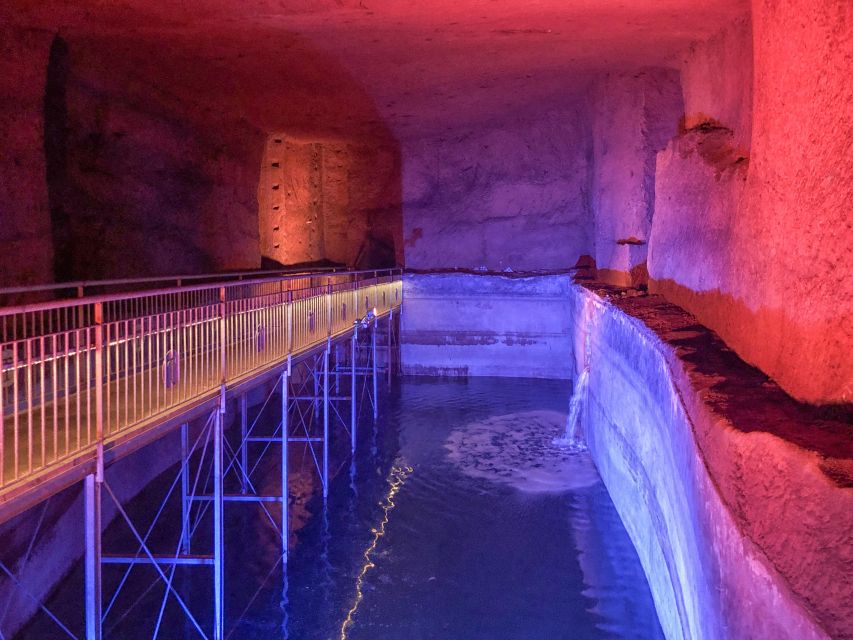
Reviewed · MUSEUMS
Naples: LAPIS Museum Guided Visit in Italian
Naples gets more intriguing the farther down you go. Beneath the Basilica of Pietrasanta, the Lapis Museum follows ancient Greco-Roman cisterns and water channels through the city’s historic center, ending 35 meters below street level.
I like two things right away: the small group of up to 10 people, which should make the Italian explanation easier to follow, and the short ride in Naples’ first archaeological lift. The lift connects the basilica crypt with the underground levels in about 20 seconds.
The main drawback is clear: this is not a good choice if you have a mobility impairment or use a wheelchair. The tour is in Italian only, and the underground setting may also feel less comfortable for anyone uneasy with enclosed spaces.
In This Review
- Key points
- Beneath the Basilica of Pietrasanta
- The Museo dell’Acqua di Napoli
- The 20-second descent to 35 meters
- Colored light on stone and water
- What the 75-minute schedule feels like
- Small group, Italian guide, and tour quality
- Is $15 a good value?
- Who should book the Lapis Museum
- Should you book this underground Naples tour?
- FAQ
- How long does the Lapis Museum tour last?
- What language is the tour offered in?
- How deep does the archaeological lift descend?
- What does the tour include?
- How many people can join the group?
- Is the tour suitable for wheelchair users?
Key points
- Ancient cisterns below a basilica: See Greco-Roman water structures beneath the Basilica of Pietrasanta.
- A 35-meter archaeological lift: Reach the underground levels in about 20 seconds.
- The Museo dell’Acqua di Napoli: Learn how water shaped Naples through its historic hydraulic system.
- Colored lighting underground: Lights and colors bring out the cisterns, vaults, and water channels.
- A 75-minute Italian tour: The experience is compact and focused, with a maximum of 10 participants.
- A low-cost historic visit: At $15 per person, the tour offers a specialized Naples experience for modest cost.
Beneath the Basilica of Pietrasanta
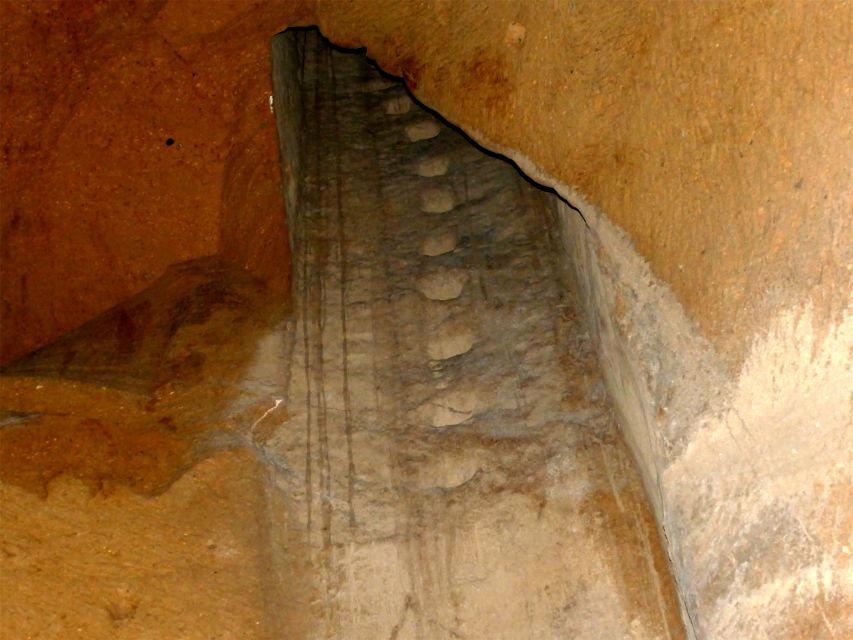
The tour begins in one of Naples’ most unusual settings: the basement of the Basilica of Pietrasanta. Above ground, you are in the historic center. Below it, the city changes character quickly, with crypt spaces, old masonry, cisterns, and water routes.
The basilica itself was built on the remains of an ancient temple dedicated to the goddess Diana. The later complex was created in the mid-17th century by architect Cosimo Fanzago, so the underground visit brings together several different periods of Naples in one place.
That layering is what gives the tour its interest. You are not simply looking at an old room below a church. You are following the remains of a water system connected to the development of the city, inside a religious complex built centuries later over an ancient site.
The route is known as the Submerged Decumanus. The name points to the way Naples’ underground spaces connect with the city’s old street and drainage systems. You should not expect a broad museum with many separate galleries. This is a guided path through a specific underground environment, with the guide helping you understand how the spaces fit together.
More museums and sites in Naples:
- Naples: National Archaeological Museum Ticket & Audio App
★ 4.4 · 617 reviews - Naples: National Archaeological Museum of Naples Guided Tour
★ 4.8 · 498 reviews - Naples: National Archaeological Museum Tour & Digital Guide
★ 4.2 · 177 reviews
The Museo dell’Acqua di Napoli
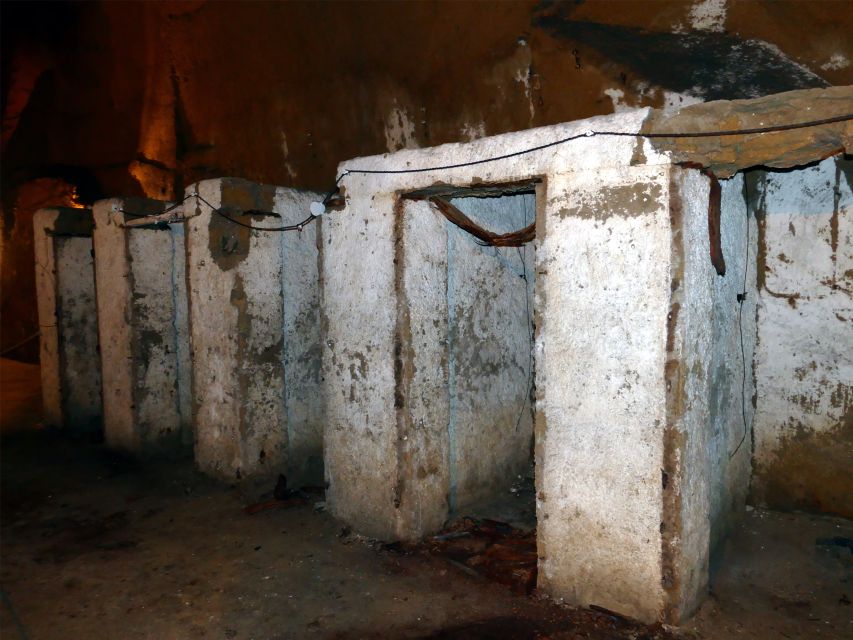
The Museo dell’Acqua di Napoli forms the central part of the underground route. Its focus is Naples’ water system, especially the hydraulic engineering that allowed ancient cisterns to collect, hold, and move water.
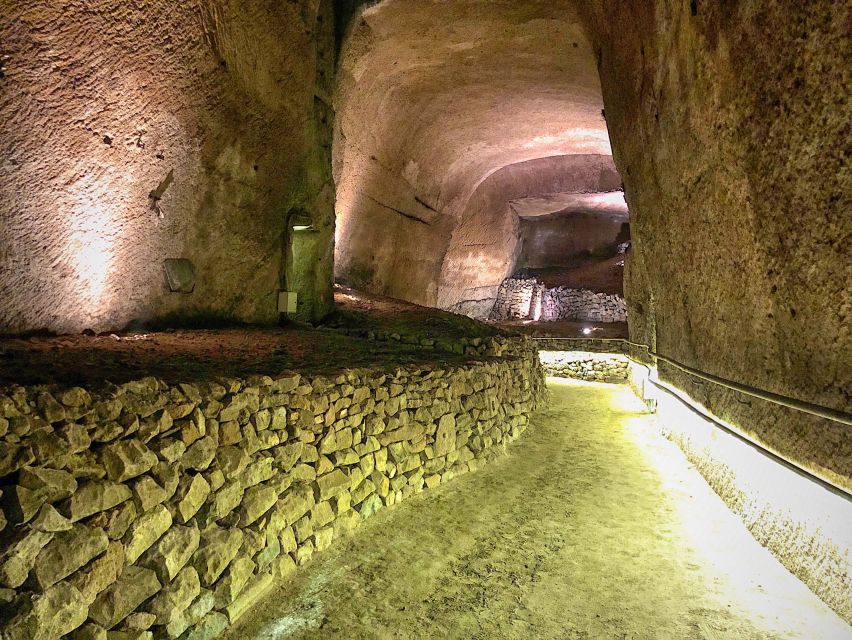
The water museum matters because it gives the underground rooms a purpose. Without that context, a cistern can look like a large stone chamber with a curved ceiling. With an explanation of water collection and runoff, the shape of the rooms becomes easier to read.
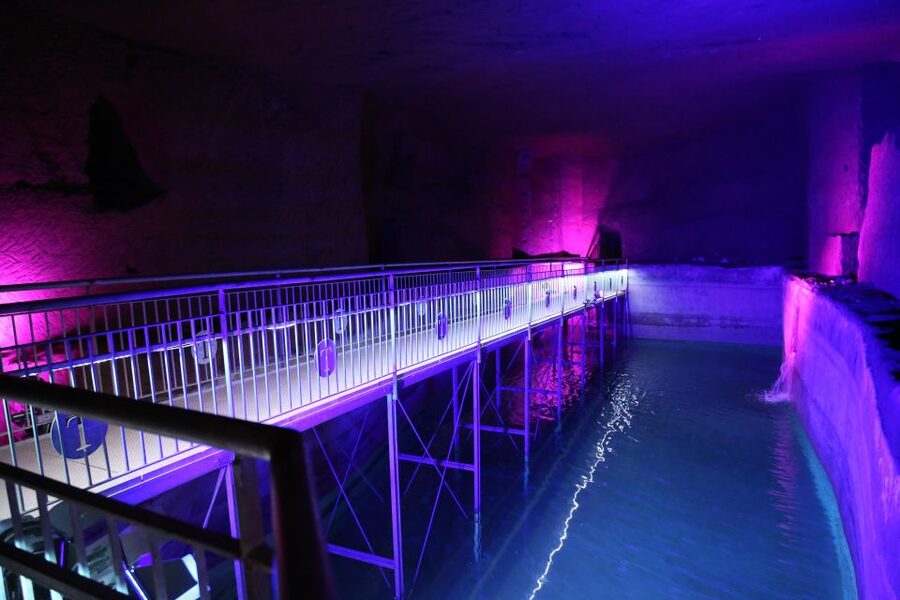
The ancient cisterns are not presented as dry ruins alone. Water and runoff still reach parts of the system, helping you see why these spaces were built with particular slopes, surfaces, and vaulted ceilings. The underground route brings old engineering into view rather than treating it as a collection of disconnected remains.
I especially like this kind of museum visit because it shows an ordinary part of city life. Aqueducts and reservoirs rarely receive the same attention as churches and palaces, yet dependable water shaped where people could live and how a city could grow.
The information is delivered by an Italian-speaking live guide. If you understand Italian, the guided format should add useful detail about the cisterns and the basilica. If you do not speak Italian, this is a less suitable choice than a tour with an English option, since the advertised language is Italian only.
The 20-second descent to 35 meters
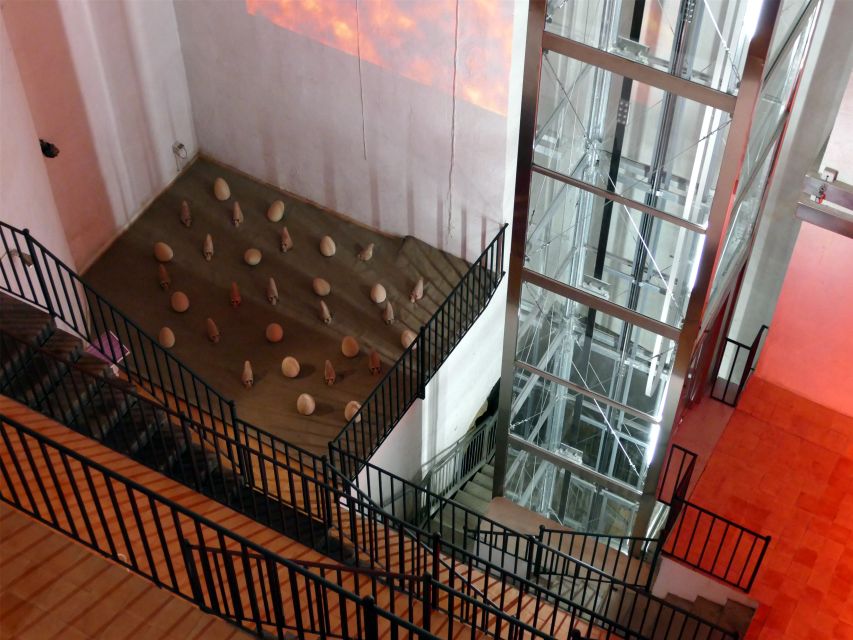
One of the tour’s most distinctive features is the archaeological lift. It connects the crypt to the underground area and descends to a depth of 35 meters in about 20 seconds.
That ride is more than a practical way to save time. It gives the experience a clear transition from the church above to the water system below. In a few seconds, you move from the historic center at street level to spaces linked with roughly 2,000 years of urban development.
The lift is described as the first archaeological lift in Naples’ historic center. That makes it an important part of the visit, especially for anyone interested in how modern access has been added to an old archaeological site.
The quick descent also helps the 75-minute schedule work well. You do not spend most of your visit walking through a long access tunnel. The tour can focus on the crypt, cisterns, museum displays, and underground route.
Still, the lift may not suit everyone. The descent is quick, and the tour takes place below ground. If you feel uncomfortable in enclosed spaces, you may want to consider that before booking. The activity is also specifically marked as unsuitable for people with mobility impairments and wheelchair users.
Colored light on stone and water
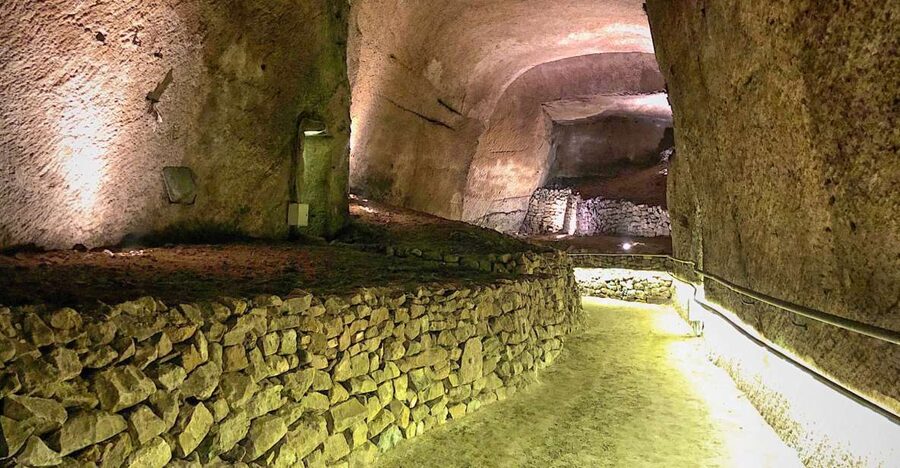
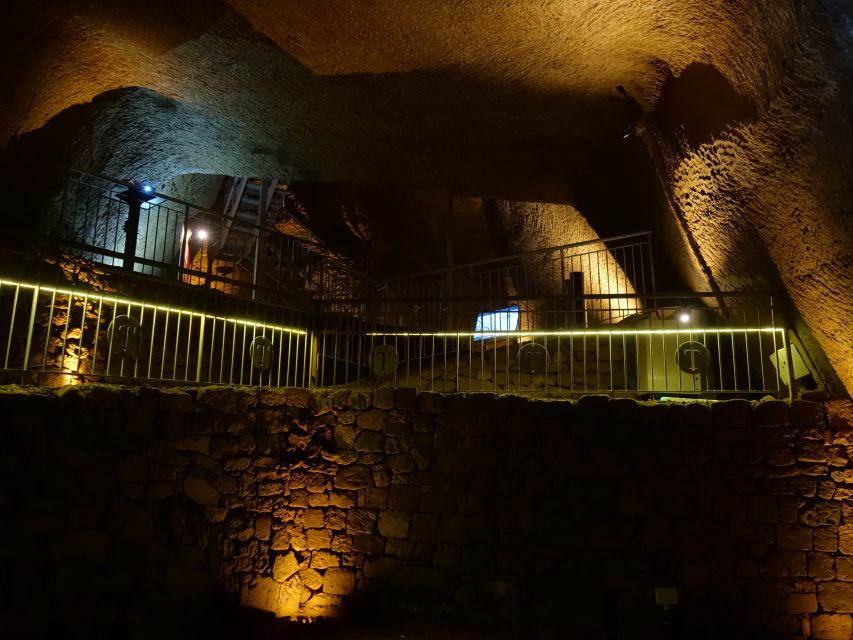
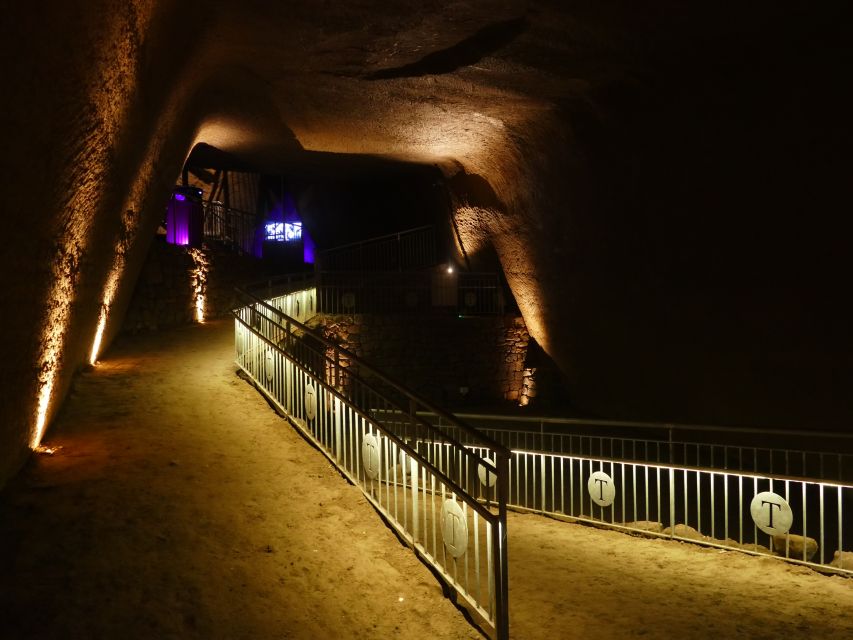
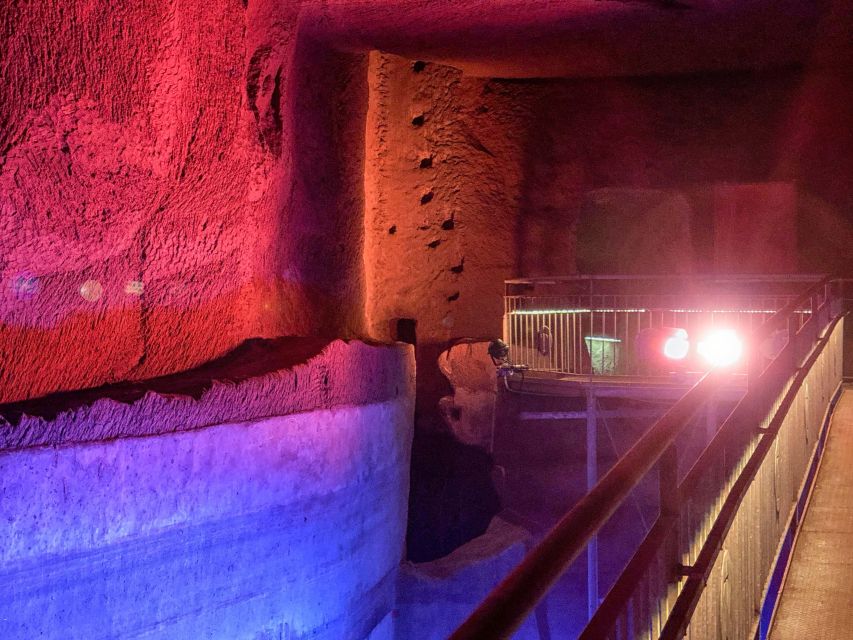
The underground rooms have been enhanced with a technical lighting system. Lights and colors emphasize the volume of the cisterns, the curve of the vaults, and the areas where water or runoff remains.
This lighting gives the route a more dramatic appearance than a plain archaeological inspection. It helps direct your attention to the shape of the chambers, especially where darkness would otherwise hide the ceiling and edges of the masonry.
There is a tradeoff. Colored lighting can make an ancient site easier to see, but it also gives the experience a designed, theatrical quality. If you want a completely bare archaeological setting, the lighting may feel less traditional. If you want to understand the form of the rooms and take in the atmosphere, it adds real value.
The most useful part is not the color itself. It is the way the lights help you read the underground architecture. Vaults matter because of how they support the space. Channels matter because of how water moved through them. The illumination makes those details more apparent during a short visit.
A few more Naples trips worth weighing up
- Naples: Catacombs of San Gennaro Entry Ticket & Guided Tour
★ 4.6 · 7,941 reviews - Naples: Spanish Quarters Underground Guided Tour
★ 4.8 · 5,064 reviews - Naples: Street Food Walking Tour with Local Guide
★ 4.8 · 4,256 reviews - Herculaneum: Skip-the-Line Guided Tour with Archaeologist
★ 4.8 · 3,439 reviews
What the 75-minute schedule feels like
A 75-minute duration is long enough for a focused introduction to the site without taking over your day in Naples. The tour has a defined subject, so you are unlikely to spend time waiting through unrelated sections.
You can expect the visit to move through several connected parts:
- Entry into the Basilica of Pietrasanta and its crypt
- Descent by the archaeological lift
- Guided exploration of the Museo dell’Acqua di Napoli
- Passage through the ancient cisterns and the Submerged Decumanus
- Attention to the water, runoff, vaults, and illuminated masonry
- Return through the underground route and lift connection
The exact order can depend on site operations, but the experience is built around this movement from basilica to subsoil.
A 75-minute tour also makes this easy to add between other sights in central Naples. At the same time, you should allow some extra time around the scheduled start because the meeting point and entrance timing matter. The provider asks you to use the supplied mobile number for same-day help, delays, or changes to the entrance time.
The activity must be booked no later than 24 hours before your desired visit. That is worth noting if you are planning Naples day by day and hoping to decide at the last minute.
Small group, Italian guide, and tour quality
With no more than 10 participants, this is a much more personal format than a large underground group. A small group should make it easier to hear the guide and to pause at the key features without a crowd filling the chamber.
The guide speaks Italian, and the tour is presented as a live guided visit rather than a self-guided walk. That matters here because the water system is not always self-explanatory. A guide can connect the basilica, the temple remains, the aqueducts, and the cisterns into one story.
The available feedback points to careful organization and strong guide preparation. One Italian visitor described the route as very interesting and praised the guide’s preparation, while another called the path fascinating and emotional. Those comments match the strengths of the format: a short route, a clear topic, and a guide who can explain what you are seeing.
One useful note from the feedback is the hope that additional entrances may open in the future. That suggests access to this part of Naples is still developing. For now, you should treat the route as a specific organized visit rather than assuming there are many ways to enter the underground complex independently.
Is $15 a good value?
At $15 per person, this is one of the easier Naples experiences to justify on price. Admission and an Italian-speaking guide are included, and the visit lasts 75 minutes. You are paying for access to an underground site that is not simply a public street or open church interior.
The value is strongest if you enjoy archaeology, old water systems, or unusual views of familiar cities. You receive a guided look at the Basilica of Pietrasanta’s basement, the Museo dell’Acqua di Napoli, ancient cisterns, and the 35-meter descent. That is a lot of focused content for a modest fee.
The value is weaker if you do not understand Italian. The listed language is Italian only, so you may miss much of the explanation even if the rooms and lighting remain visually interesting.
You should also consider the activity’s limits. It is not a full tour of Naples, and it does not cover several major city sights. Think of it as a specialized underground visit that works best alongside your other plans, not as a replacement for seeing Naples above ground.
Free cancellation is available up to 24 hours before the visit, and you can reserve now and pay later. Those terms help if your schedule is still taking shape, but the separate 24-hour booking cutoff means you cannot count on a same-day reservation.
Who should book the Lapis Museum
I would recommend this visit to you if you want a different side of Naples than churches, viewpoints, and street life. It suits people who enjoy old engineering, layered city history, and places that explain how urban life worked behind the scenes.
It is also a good fit for:
- Italian speakers looking for a compact guided visit
- Couples and small groups who prefer a limited group size
- History fans interested in Greco-Roman remains and 17th-century architecture
- Families with older children who can manage an underground tour
- Visitors looking for a low-cost activity in Naples’ historic center
- Anyone who wants to see Naples from below rather than only from its streets
I would skip it if you need wheelchair access, have a mobility impairment, or want an English-language guide. I would also think twice if enclosed underground spaces make you uncomfortable.
The tour is best for a curious mind rather than someone seeking a major spectacle. Its appeal comes from the connection between water, architecture, and city growth. The lift and colored lighting add drama, but the real subject is the old hydraulic system.
Should you book this underground Naples tour?
Book it if you speak Italian and want a 75-minute look at Naples’ water history for $15. The 35-meter lift ride, small group, and atmospheric cisterns give the visit a clear identity, while the basilica, temple remains, and water museum add useful context.
Skip it if you need step-free access or an English tour. For the right visitor, though, the Lapis Museum offers a compact and unusual way to understand Naples: not from a grand viewpoint, but through the stone chambers and water routes beneath the city.
FAQ
How long does the Lapis Museum tour last?
The guided visit lasts 75 minutes.
What language is the tour offered in?
The live tour guide speaks Italian, and Italian is the listed tour language.
How deep does the archaeological lift descend?
The lift descends to 35 meters below ground and takes about 20 seconds to make the connection from the crypt to the underground area.
What does the tour include?
The price includes the admission ticket and an Italian-speaking tour guide.
How many people can join the group?
The tour is limited to 10 participants.
Is the tour suitable for wheelchair users?
No. The experience is listed as unsuitable for wheelchair users and people with mobility impairments.
Just added around Naples
- Full-Day Tour of the Amalfi Coast and Pompeii from Naples★ 4.5 · 3 reviews
- The Ultimate Neapolitan Cooking Class with Local★ 5.0 · 3 reviews
- Visit in Pompeii – Naples Private Tour with Ada★ 5.0 · 3 reviews
- Transfer from Naples to Sorrento or viceversa★ 5.0 · 3 reviews
- Naples: Old City Center Street Food Tour with Spritz★ 4.7 · 3 reviews
- Naples: National Gallery of Capodimonte Tour★ 5.0 · 3 reviews
- Visit 2 wine producers with tasting and transportation included★ 5.0 · 3 reviews
- Naples: Mozzarella experience★ 5.0 · 3 reviews
Museums, compared.
National Archaeological Museum Ticket & Audio App
Read our review →
National Archaeological Museum of Naples Guided Tour
Read our review →
National Archaeological Museum Tour & Digital Guide
Read our review →


Sant’Aspreno ai Crociferi: Church & Jago Museum Guided Tour
Read our review →
Skip the Line: National Archaeological Museum of Naples Entry Ticket
Read our review →
Browse the lists this tour appears in