
Reviewed · POMPEII TOURS
Pompeii Guided Walking Tour – Skip-the-Line Priority Access
Pompeii is so large that a first visit can feel like wandering through a city without a map. This two-hour guided walk gives you a clear route through the central excavations, from the old harbor gate to the Forum, baths, shops, elite homes, and brothel. I especially like the focus on everyday Roman life, not just emperors and volcanoes, and the priority access that helps you spend more time inside the ruins. The trade-off is simple: two hours covers only a small part of Pompeii, so you’ll need extra time afterward if you want to see more.
I also like the manageable pace. You get a useful introduction without committing to a full-day archaeological march, and the tour leaves room for independent exploring. Take the meeting instructions seriously, though. One past booking became difficult because the directions did not match the information given locally, so arrive early at Porta Marina Inferiore and look for a guide holding the local operator’s logo.
In This Review
- Key points at a glance
- Why a two-hour Pompeii tour can work well
- Meeting at Porta Marina Inferiore
- Entering through Pompeii’s harbor gate
- The Forum, where public Pompeii gathered
- Baths, streets, and the rhythm of daily life
- House of the Faun and the private side of Pompeii
- The Lupanar and Roman social customs
- New excavations and the final days before 79 AD
- What the guide adds, and where the format falls short
- Who should book this Pompeii walk
- Should you book it?
- FAQ
- How long does the Pompeii guided tour last?
- What languages are available?
- Where do I meet the guide?
- Is transportation included?
- Does the tour include Pompeii’s entrance fee?
- What should I bring?
- Can I cancel for a full refund?
- Is entry guaranteed on the first Sunday of the month?
Key points at a glance
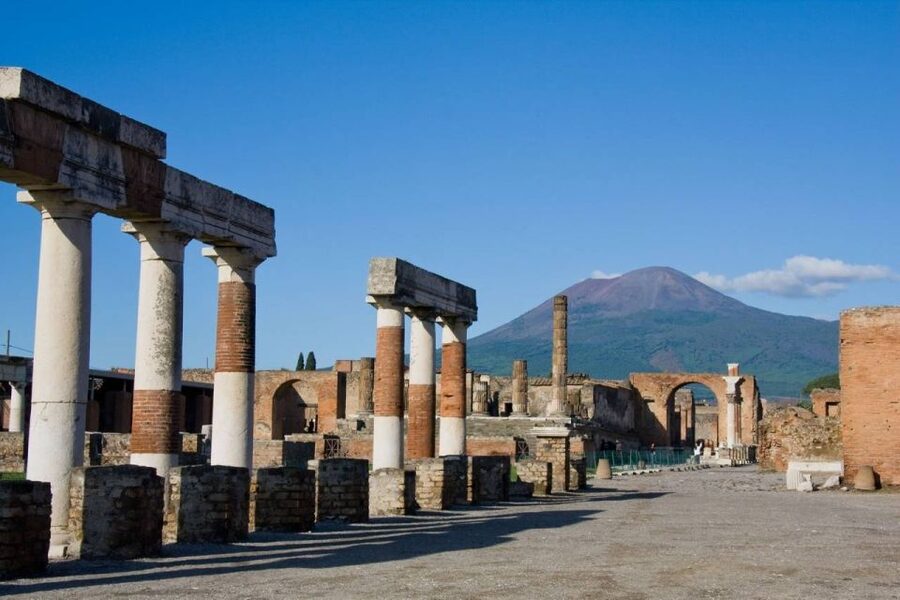
- Enter through ancient Porta Marina: Begin at one of Pompeii’s historic gateways, once linked with the city’s harbor.
- See the Forum first: Stand at the center of Pompeii’s political, religious, and commercial life.
- Walk Via dell’Abbondanza: Ancient shops, bakeries, and taverns make Roman daily routines easier to picture.
- Visit major homes and public buildings: The House of the Faun, baths, temples, and basilica show the gap between public duty and private luxury.
- Hear about Roman leisure and customs: The Lupanar adds a frank, useful look at social life in the city.
- Plan for more Pompeii afterward: The route covers the central highlights, but not close to the whole archaeological park.
Why a two-hour Pompeii tour can work well
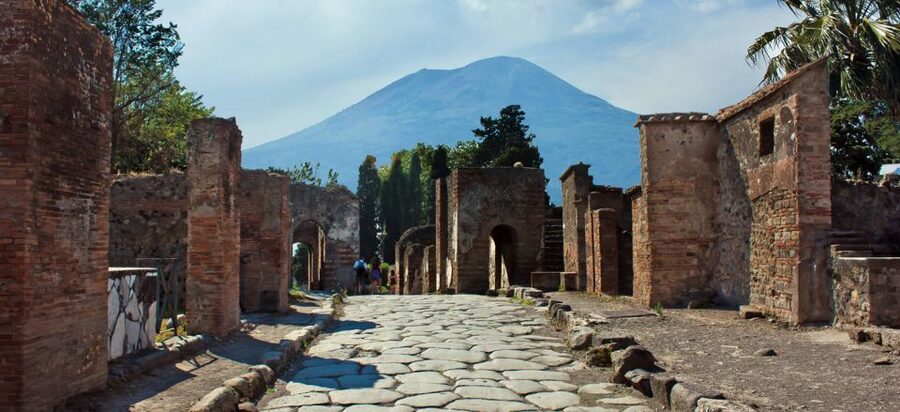
Pompeii is not a compact museum. It is a buried Roman city spread across a large archaeological area, with streets, homes, temples, baths, theaters, businesses, and open public spaces. Without a plan, you can spend much of your visit reading signs and trying to work out where you are.
This tour gives you a beginning, middle, and end. You meet at Porta Marina Inferiore, enter the excavation area, and follow a route through the city’s central sights. The guide supplies the setting and connections that individual labels often cannot.
At $47 per person, the value rests mainly in the guiding and the time saved at entry. You are paying for a two-hour authorized tour, an entrance fee, and priority access to buy your ticket. If you only have a short window in Pompeii, that combination is useful. If you already know the site well or plan to spend many hours reading and exploring alone, the guided portion may feel less essential.
The tour is offered in English and Italian. Starting times vary, so you’ll need to check availability for your date. The activity does not include transport, which is important if you are coming from Naples, Sorrento, or another Campania base. You arrange your own way to Pompeii and meet the guide there.
More ways to see Pompeii:
- From Naples: Pompeii Ruins & Mount Vesuvius Day Tour
★ 4.3 · 11,459 reviews - Naples or Sorrento: Full-Day Pompeii and Mount Vesuvius Tour
★ 4.6 · 4,235 reviews - Pompeii & Mt.Vesuvius Day Tour from Naples with Pizza Lunch
★ 4.0 · 2,901 reviews
Meeting at Porta Marina Inferiore
The meeting point is in Piazza Esedra, at Porta Marina Inferiore. Your guide will hold a board with the local tour operator’s logo.
This sounds straightforward, but I would not treat it casually. Clear meeting instructions matter at a site with several entrances and a steady flow of tour groups. One booking became a real problem because the online directions and the information from the local office did not agree. The best practical move is to arrive early, stand near the stated gate, and look for the guide’s board rather than joining the first group you see.
The meeting point also sets the tone for the tour. Porta Marina was once the main entrance from Pompeii toward its harbor. As you pass through, you are not simply entering an archaeological park. You are following the same broad route used by people arriving in the ancient city for trade, work, worship, or public business.
There is no transport included, and the tour starts at the site. Plan your route before the day of the visit, especially if you are relying on a train, bus, or taxi. The activity information does not give a group size, so you should not book it expecting a private tour unless that is confirmed separately.
Entering through Pompeii’s harbor gate
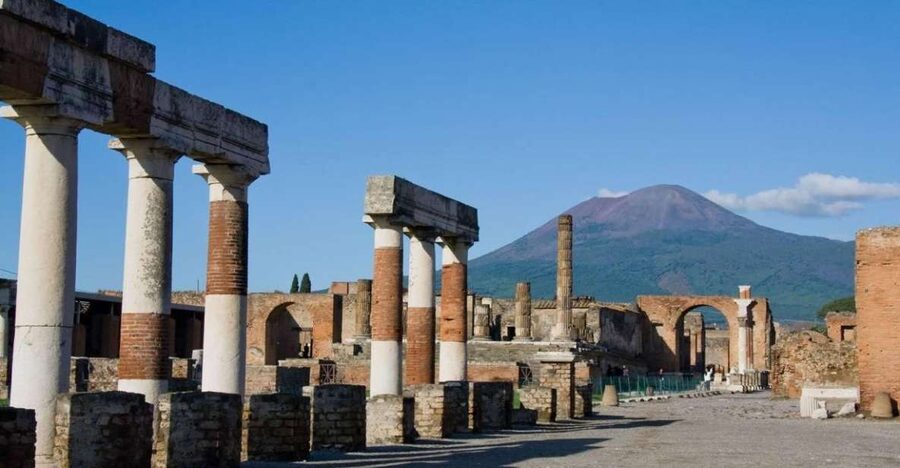
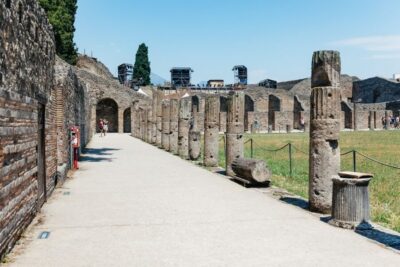
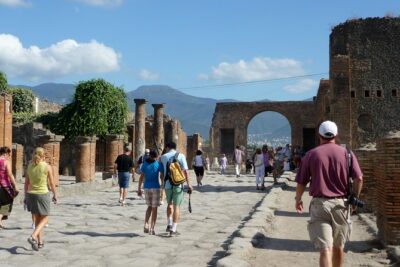
The walk begins at Porta Marina and follows original Roman streets. This first stretch gives the guide a chance to explain how Pompeii functioned as a real city rather than a collection of isolated ruins.
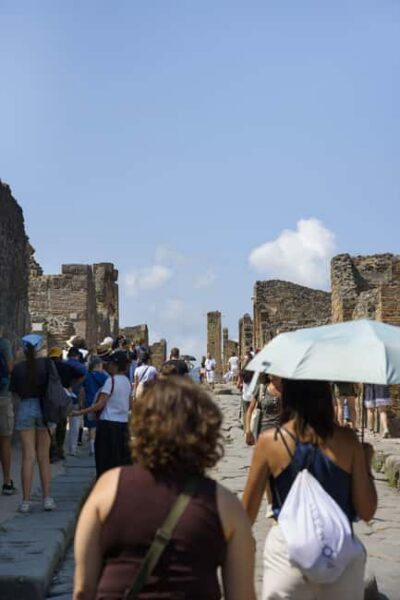
The streets are one of the best parts of the site. You can see how movement, trade, and public life were arranged around them. The stones underfoot and the remains of buildings along the route help turn a broad date such as 79 AD into something more concrete.
The eruption of Mount Vesuvius is the event most people associate with Pompeii, but the tour’s main value is showing what life looked like before the disaster. You’ll hear about the city’s institutions, businesses, homes, bathing habits, and social customs. That wider view keeps the visit from becoming only a story about destruction.
Wear comfortable shoes. This is a walking tour over ancient streets, and the information specifically advises practical footwear. You should also be ready for a steady route rather than a stop-and-start visit where you can linger at every building.
The Forum, where public Pompeii gathered
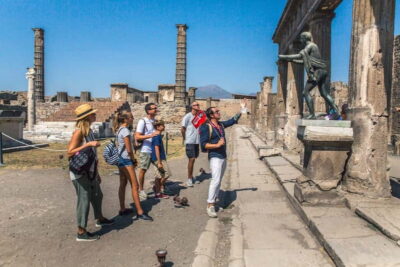
The Forum is the central set piece of the tour. In Roman cities, this was where political, religious, and commercial life met. Pompeii’s Forum is surrounded by major structures, including the Basilica, Temple of Jupiter, and Temple of Apollo.
This is a good point to have a guide because the open space can be hard to read on your own. The buildings no longer operate as they once did, of course, but their positions show how the city organized authority and public ceremony. The Basilica points to civic and legal business. The temples show the religious side of city life. The Forum itself acted as a shared stage for public activity.
The guide’s job here is not simply to name each ruin. You want an explanation of how the pieces worked together. Past feedback includes strong praise for guides who explained Pompeii’s history and past in a clear, professional way. That strength matters most in spaces such as the Forum, where a few well-placed details can make the bare walls and columns easier to understand.
One caution: this route may pass some famous places without stopping for a long explanation. A past participant felt that several must-see areas received little more than a name and brief information. If you want detailed treatment of every major building, two hours will not be enough.
More walking tours in Naples:
- Naples: Street Food Walking Tour with Local Guide
★ 4.8 · 4,256 reviews - Naples Spanish Quarters Walking Tour Street Art, Folklore & Sweet
★ 5.0 · 797 reviews - Naples: Old Town Guided Walking Tour
★ 4.8 · 553 reviews - Naples: Panoramic Walking Tour with Funicular
★ 4.8 · 543 reviews
Baths, streets, and the rhythm of daily life
The route continues to either the Forum Baths or the Stabian Baths, depending on the itinerary used that day. These public bathing complexes were more than places to wash. They were social spaces where people could relax, meet others, and follow a familiar part of Roman city life.
This section helps balance the grand public monuments. The Forum tells you how Pompeii presented itself. The baths show how people spent ordinary leisure time. I like that contrast because it brings the city down from official ceremonies to daily habits.
Via dell’Abbondanza adds another practical layer. This lively ancient street was lined with shops, bakeries, and taverns. Even when only fragments survive, the commercial character of the road is easy to picture. The guide can help you connect the street layout with the kinds of work and shopping that filled a normal day.
If everyday life is your main interest, listen closely during this part of the walk and ask questions when there is a natural pause. One past booking specifically wanted more information about ordinary life and less emphasis on general history. That is useful advice: tell the guide what interests you early. A good tour can cover both, but your preferences help shape the experience.
The pace may feel quick if you want to take many photographs. One participant found it necessary to hurry to keep up after stopping for pictures. Pompeii is visually generous, so it is tempting to pause at every doorway. Try to take a few shots, then return your attention to the guide and mark places you want to revisit after the tour.
House of the Faun and the private side of Pompeii
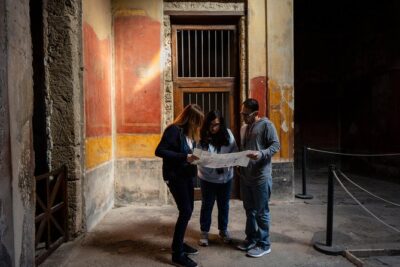
The House of the Faun is one of the city’s largest and most luxurious private residences. Its size and decoration reveal a side of Pompeii far removed from the small shops and working streets.
The house is especially useful for understanding Roman social differences. Public buildings belonged to the whole community, but elite homes displayed status through scale, layout, mosaics, and refined architectural details. A guide can explain how a residence such as this fit into the culture of wealth and hospitality.
Do not expect to examine every room at length. The tour is designed around the central highlights, and the House of the Faun is one stop among many. If its mosaics and architecture interest you most, note the location and return independently when the guided walk ends, provided site access and opening conditions allow.
This is one reason the tour’s limited coverage can be a benefit rather than a flaw. A focused introduction gives you a framework. You can then spend your remaining time choosing between houses, streets, public buildings, and recently excavated areas instead of trying to see everything at random.
The Lupanar and Roman social customs
The Lupanar, or brothel, is included as part of the route. It offers a more direct look at Roman social customs and the kinds of leisure activities found in Pompeii.
The stop is not presented as a novelty alone. Its value is that it adds another piece to the city’s social picture. After temples, baths, shops, and grand homes, the Lupanar shows how Pompeii’s public and private worlds overlapped in ways that may feel unfamiliar today.
As with other popular sections, the amount of time spent there can vary with the guide and the pace of the group. If you want a detailed interpretation of the paintings, rooms, and social context, ask the guide for more explanation. The supplied information promises insight into how citizens spent leisure time, but it does not promise a long specialist lecture at this one building.
New excavations and the final days before 79 AD
The route may include recently excavated areas and new archaeological findings. These sections add a useful reminder that Pompeii is not a finished picture. Archaeologists continue to refine what is known about the city and the people who lived there.
That matters because the familiar Pompeii story can become too neat: prosperous Roman town, volcanic eruption, sudden burial. New discoveries can add detail to the final days and show that the city had a more complex life than the standard tale suggests.
The guide connects these findings with the period before Mount Vesuvius erupted in 79 AD. You get a sense of a working city in the middle of its own affairs, not a ruin waiting for modern visitors.
Still, the tour cannot cover every new area. Its route focuses on the central part of Pompeii and is designed to fit into two hours. Treat the walk as an orientation and highlight visit, not a complete archaeological survey.
What the guide adds, and where the format falls short
The strongest part of this experience is the human explanation. A professional authorized guide can point out why a building mattered, how a street was used, and what a ruin suggests about Roman society. Past feedback gives the guiding high marks for professionalism, education, and an engaging approach.
The two-hour length also works well for many schedules. One participant considered it the right amount of time for an overview, with room left for further investigation. That is a sound way to view the tour. You get enough structure to understand the site, but you are not committed to a full day of following someone else’s route.
The limits are just as clear. Pompeii is huge, and this walk covers less than a quarter of it. If you want the amphitheaters, theaters, gardens, distant houses, or other outer sections, you need additional time and a map. The tour will not replace independent exploration.
The other issue is pace. A group moving through a major archaeological site cannot wait for every photograph or question. If you stop often, you may need to catch up. I would take quick pictures during the walk and save longer photo sessions for the places you revisit afterward.
Who should book this Pompeii walk
I would choose this tour if you are visiting Pompeii for the first time and want the main central sights explained in plain terms. It suits you especially well if you have about half a day, want a guided start, and prefer to continue independently once you know the layout.
It also fits visitors who care about daily Roman life as much as famous monuments. The route includes baths, shops, bakeries, taverns, homes, and the Lupanar, not just temples and political buildings.
You may want a different plan if you have already studied Pompeii, want a specialist focus, or plan to spend a full day on site. In that case, a general two-hour overview may leave you wishing for more detail at individual buildings.
The $47 price is fair when you use the entrance fee and guided orientation. It is less compelling if you mainly want admission and plan to walk alone. The priority access is most helpful when ticket lines are long, though entry conditions can change.
Free cancellation up to 24 hours before the start gives you some flexibility, and you can reserve now and pay later. On the first Sunday of each month, admission is free, but tickets cannot be reserved ahead of time and entry is not guaranteed. That is a poor day to depend on a prearranged priority-entry plan.
Should you book it?
Book this Pompeii tour if you want a clear two-hour introduction with an authorized English or Italian guide, priority access, and the central sights in one sensible route. It is a practical choice for a first visit and leaves you free to explore after the guided portion.
Skip it if you want to cover most of the archaeological park, stop for long photo sessions, or study each building in detail. Arrive early at Porta Marina Inferiore, confirm the meeting point, wear comfortable shoes, and allow extra time after the tour. Used that way, the experience gives you a solid start without pretending that two hours can explain all of Pompeii.
FAQ
How long does the Pompeii guided tour last?
The guided walking tour lasts two hours.
What languages are available?
The live guide is available in English and Italian.
Where do I meet the guide?
You meet the guide at Porta Marina Inferiore, in Piazza Esedra. The guide will hold a board with the local tour operator’s logo.
Is transportation included?
No. Transport to and from Pompeii is not included.
Does the tour include Pompeii’s entrance fee?
Yes. The activity includes the entrance fee and priority access to buy the entrance ticket.
What should I bring?
Wear comfortable shoes. You should also bring a passport or ID card for children.
Can I cancel for a full refund?
Yes. You can cancel up to 24 hours in advance for a full refund.
Is entry guaranteed on the first Sunday of the month?
No. Entrance is free on the first Sunday of each month, but tickets cannot be reserved ahead of time, so entry is not guaranteed.
More Skip the Line in Naples
- Herculaneum: Skip-the-Line Guided Tour with Archaeologist
★ 4.8 · 3,439 reviews - Mount Vesuvius: Skip-the-Line Ticket and Smart Digital Guide
★ 4.2 · 2,780 reviews - From Naples: Pompeii Skip-the-Line Entry Ticket and Tour
★ 4.4 · 2,753 reviews - Pompeii: Skip-the-Line Entry Ticket with Audio Guide or Tour
★ 4.1 · 1,364 reviews
Just added around Naples
- Full-Day Tour of the Amalfi Coast and Pompeii from Naples★ 4.5 · 3 reviews
- The Ultimate Neapolitan Cooking Class with Local★ 5.0 · 3 reviews
- Transfer from Naples to Sorrento or viceversa★ 5.0 · 3 reviews
- Naples: Old City Center Street Food Tour with Spritz★ 4.7 · 3 reviews
- Visit in Pompeii – Naples Private Tour with Ada★ 5.0 · 3 reviews
- Naples: National Gallery of Capodimonte Tour★ 5.0 · 3 reviews
- Visit 2 wine producers with tasting and transportation included★ 5.0 · 3 reviews
- Naples: Mozzarella experience★ 5.0 · 3 reviews
Pompeii Tours, compared.
Pompeii & Mt.Vesuvius Day Tour from Naples with Pizza Lunch
Read our review →
Pompeii & Mt Vesuvius All-Inclusive Small Group w/ Lunch
Read our review →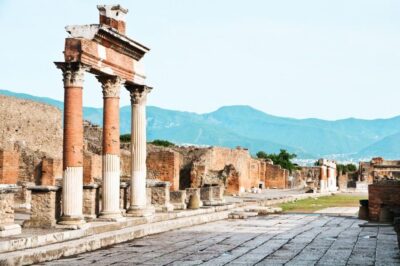

Pompeii & Amalfi Coast Full-Day Trip with Lunch
Read our review →Browse the lists this tour appears in