

Reviewed · POMPEII TOURS
Pompeii and Herculaneum day trip
Pompeii and Herculaneum tell two very different stories of the same volcanic disaster. Pompeii is vast and urban, with broad streets, theaters, baths, shops, and grand houses. Herculaneum is smaller, but its buildings and household details are often better preserved. Seeing both in one day gives you a useful side-by-side look at Roman life.
I like the private car and flexible schedule, especially if you are staying in Naples, arriving by cruise ship, or traveling with children. I also like the choice between exploring independently and adding a guide such as Antonino, Anna, or another professional from the company. The main drawback is the pace: six to seven hours is enough for a strong overview, but not enough to inspect every corner of Pompeii.
In This Review
- Key points to know before booking
- Why visiting both ruins makes sense
- Leaving Naples in a private vehicle
- Pompeii’s Forum and the main city streets
- Pompeii’s houses, baths, and darker side
- What the two-hour Pompeii visit leaves out
- Herculaneum’s smaller, better-preserved streets
- Public life at the College and baths
- Price, entrance fees, and what you receive
- Who will enjoy this day most
- Practical booking advice for Naples
- Should you book this Pompeii and Herculaneum trip?
- FAQ
- How long does the Pompeii and Herculaneum day trip last?
- Where can pickup and drop-off take place?
- Is transportation private?
- Are entrance fees included?
- Is a guide included?
- Can I cancel for a full refund?
Key points to know before booking
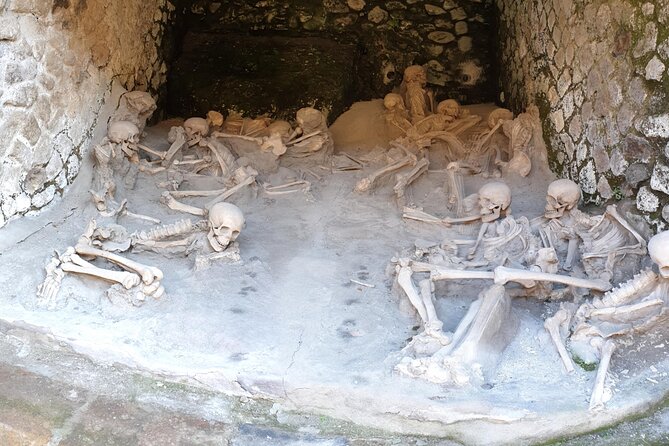
- Pompeii and Herculaneum in one day: You see the larger, more famous site and the smaller, more intact town without arranging separate transport.
- Private transportation from Naples: Pickup and drop-off are offered at hotels, ports, the train station, and the airport, subject to road access.
- Guide option matters: A guide is included only when you select the option that includes one. Otherwise, you visit the ruins on your own.
- Pompeii needs the most time: The itinerary gives the site about two hours, with stops at the Forum, Via dell’Abbondanza, theaters, baths, houses, and the brothel.
- Herculaneum adds household detail: The Wooden Partition House, Suburban Baths, College of the Augustales, and Antiquarium show a more compact but unusually preserved town.
- Budget for entrance fees and lunch: Admission is not included, and the stated prices require careful checking at booking because the fee wording gives both per-person and per-booking figures.
Why visiting both ruins makes sense

If you have time for only one ancient site near Naples, Pompeii is the obvious choice for scale. It was a large Roman town with public buildings, entertainment spaces, commercial streets, and private homes. You can walk through the civic center, trace the main road, and see how public and private life fit together.
Herculaneum offers a different reward. The town was covered by volcanic material that helped preserve wooden elements, upper portions of buildings, furnishings, and household features. It is smaller, so you can form a clearer picture of a neighborhood rather than spend the day crossing a huge archaeological area.
That contrast gives this outing its real value. Pompeii helps you understand the city. Herculaneum helps you notice the home. I would not treat Herculaneum as a quick extra stop after Pompeii. It deserves attention of its own, even though the visit is shorter.
The private format is helpful here. You are not tied to a large group’s timetable, and the driver can take you between Naples and the two sites without making you work out regional trains or local connections. You still need to respect the day’s limited hours, but the arrangement gives you more control.
More ways to see Pompeii:
- From Naples: Pompeii Ruins & Mount Vesuvius Day Tour
★ 4.3 · 11,459 reviews - Naples or Sorrento: Full-Day Pompeii and Mount Vesuvius Tour
★ 4.6 · 4,235 reviews - Pompeii & Mt.Vesuvius Day Tour from Naples with Pizza Lunch
★ 4.0 · 2,901 reviews
Leaving Naples in a private vehicle
Pickup is available from Naples hotels, the cruise port area, the train station, and the airport. If a vehicle cannot reach your exact address because of narrow or restricted streets, the pickup point will be the nearest accessible place. Confirm this detail before the morning of your visit.
The vehicle is air-conditioned, private, and supplied with bottled water. Only your party participates, which makes the ride more comfortable for families or small groups with different interests. It also allows the day to feel less rigid than a standard coach excursion.
A private driver is not automatically the same as a full-time archaeological guide. That distinction matters. The driver handles transportation, timing, and local logistics, while a professional guide at the ruins is included only with the appropriate booking option.
The strongest praise for this experience centers on the guides and drivers. Antonino is described as especially good at explaining Roman life in clear English, answering questions, and adjusting his approach for children and a member of one party with visual and hearing impairments. Pepino is also noted as prompt, communicative, and a capable driver. Anna receives particular praise as a Pompeii guide.
These details point to an important booking choice. If you enjoy context, stories, and help finding the most meaningful buildings, choose the guided version. If you already know the sites well or prefer to read signs and set your own route, the independent option gives you more freedom.
Pompeii’s Forum and the main city streets
The Pompeii visit begins at Porta Marina, where you meet the guide if you selected the guided option and purchase your entrance ticket. The first portion is planned for about two hours, with several short stops inside the archaeological area.
The Civil Forum is the best place to grasp Pompeii’s public life. This open civic center was surrounded by buildings linked to administration, justice, trade, markets, and worship. Even a short orientation here helps you understand that Pompeii was not simply a collection of houses preserved by ash. It was a working city with political, commercial, and religious routines.
From there, Via dell’Abbondanza gives you a sense of movement through town. The name means Street of Abundance, and it was one of Pompeii’s most prosperous roads. Look for the street’s scale and layout rather than rushing only toward famous wall paintings. Roads, sidewalks, entrances, and shop fronts reveal how Roman neighborhoods functioned.
The route then reaches the theater area. The Large Theatre, Odeon, and Quadriporticum formed an entertainment and meeting center. The Large Theatre was used for performances, while the smaller Odeon served a more intimate purpose. The surrounding spaces help you picture the social life of Pompeii beyond its homes and temples.
The itinerary allows about ten minutes at the Forum, twenty minutes on Via dell’Abbondanza, and ten minutes around the theater complex. Those times are useful as a guide, not a promise that every stop will receive the same attention. A private outing may shift time toward places that interest your group.
Pompeii’s houses, baths, and darker side
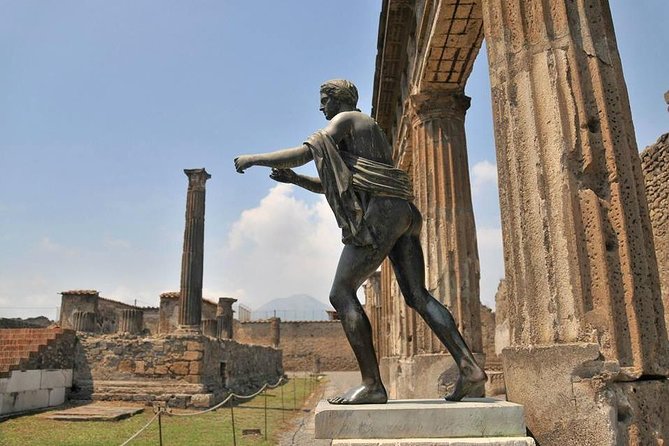
Casa del Menandro is one of the city’s grand private residences. It covers about 1,800 square meters and is noted for its architecture, decoration, and contents. This is a good stop for understanding how wealth shaped domestic space. You may find it easier to appreciate the house after seeing the public streets first, since you can compare private luxury with the town’s ordinary traffic and commerce.
The Stabian Baths are another essential stop. They are the oldest and largest of Pompeii’s five public bathing complexes. Roman baths were not just places to wash. They were social spaces, and the surviving layout gives you a practical look at how public leisure was organized.
The Lupanar, or purpose-built brothel, is one of the most talked-about spots in Pompeii. Its small rooms and erotic paintings offer a direct, if uncomfortable, glimpse into one part of Roman commercial life. The site can be crowded, and the subject matter is not suited to every child, so families should decide in advance how they want to handle this stop.
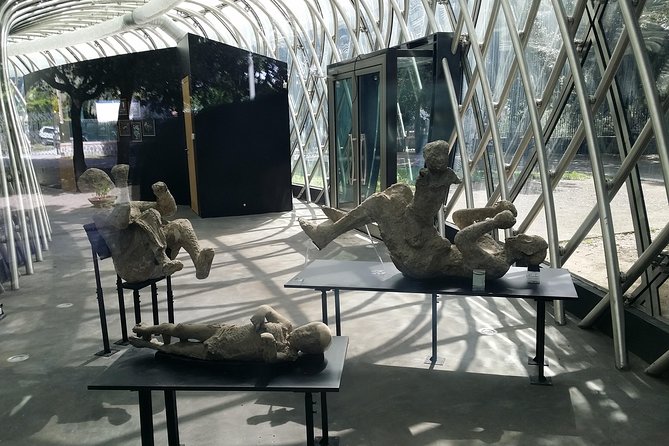
The Antiquarium provides a change of scale. Instead of walking through buildings, you see objects recovered from the excavations, material connected with daily life, and casts of victims of the eruption. Displays also trace Pompeii’s development before it became a thriving Roman city.
That museum stop can be especially helpful after the streets and houses. It places individual objects and human loss alongside the larger city plan. The itinerary gives it about ten minutes, so you should not expect a museum-length visit. If the exhibits matter greatly to you, ask how much time your guide can allow.
More Herculaneum visits from Naples:
- Herculaneum: Skip-the-Line Guided Tour with Archaeologist
★ 4.8 · 3,439 reviews - Herculaneum Small Group Tour and Ticket With an Archaeologist
★ 5.0 · 994 reviews - Herculaneum: Skip-the-Line Entry Ticket with Audio Guide
★ 4.3 · 870 reviews - From Naples: Pompeii & Herculaneum with Archaeologist Guide
★ 4.8 · 665 reviews
What the two-hour Pompeii visit leaves out
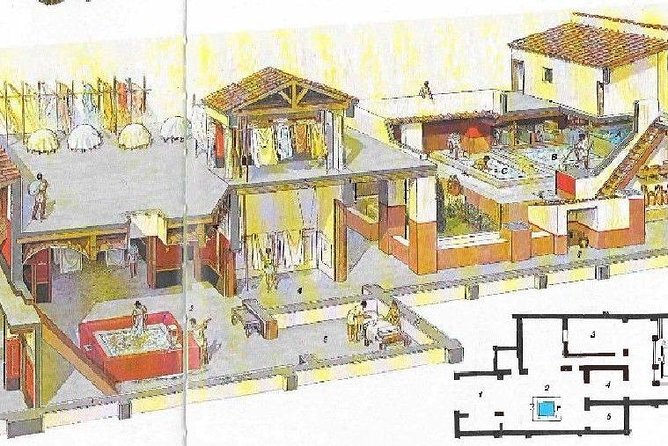
Pompeii is enormous compared with the compact section of Herculaneum open to the public. Two hours can cover the main landmarks, but it will not provide a complete visit. You may have to pass closed buildings, skip side streets, or choose between extra houses and a longer look at the Forum.
This is the chief limitation of combining both archaeological sites. The itinerary gives you a broad introduction rather than an exhaustive archaeological study. I think that tradeoff works well for a first visit, particularly if you want to compare the sites in one day. It is less suitable if Pompeii is your main reason for coming to the Naples area.
A guide can make those two hours more effective. Someone who knows the current access routes can steer you toward open and worthwhile areas instead of leaving you to spend precious time orienting yourself. Antonino is specifically praised for finding interesting corners and avoiding some of the heavier crowds.
Still, do not expect to see every celebrated building. The ruins cover a large area, and walking surfaces can be uneven. Wear practical shoes, carry water, and keep your expectations realistic. This is a substantial archaeological visit, not a quick photo stop.
Herculaneum’s smaller, better-preserved streets
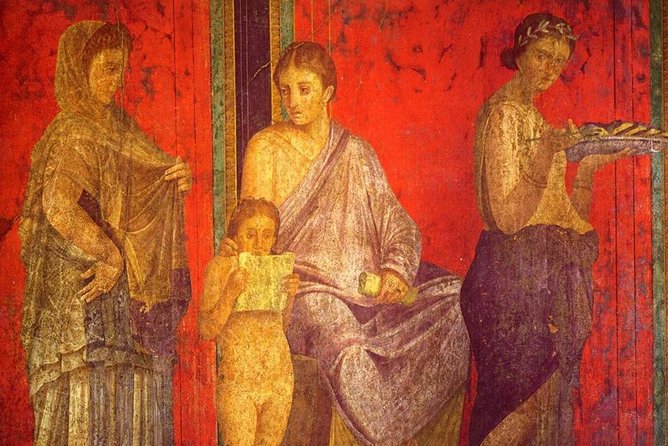
After Pompeii, the private vehicle takes you to the archaeological site of Herculaneum, also called Ercolano. The visit is shorter, but the town often feels more intimate because the excavated area is smaller and many structures retain more detail.
The House of the Hotel is a large home associated with wealth. It gives you another chance to compare domestic space with Casa del Menandro in Pompeii. The two sites were buried in different ways, and Herculaneum’s preservation can make household features easier to read.
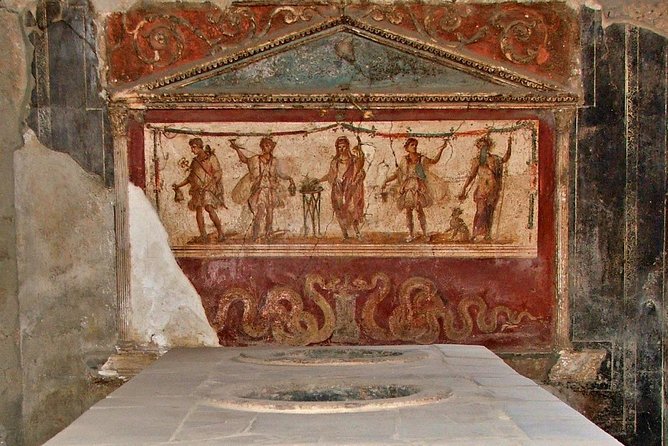
The House of the Wooden Partition is one of the most distinctive stops. Built in the pre-Roman period around the first century BC, it has a patrician facade and traces of old stucco and fresco decoration. Inside, the tablinum was divided by a wooden partition with shaped doors and large bronze rings used to support lamps.
The charred wood is important because it makes the ancient interior feel unusually tangible. At Pompeii, you often think in terms of walls, streets, and painted surfaces. Here, the remains of a wooden feature show that Roman houses contained ordinary materials that rarely survive elsewhere.
Decumano Massimo, the main street, gives you the town’s basic structure. A central road is not as dramatic as a painted villa, but it helps you understand how the buildings connected. In a compact site like Herculaneum, the relationship between street, doorway, shop, and house can be easier to follow.
Public life at the College and baths
The College of the Augustales dates from the end of the first century BC, probably around 14 BC, during the Augustan period. It was connected with the worship of the imperial family and was financed by the brothers Aulus Lucius Proculus and Aulus Lucius Iulianus.
An inscription records that the brothers provided a banquet for the Augustals and the town’s decurions at the building’s inauguration. Details like this turn a stone structure into a social setting. You can picture civic groups, status, ceremony, and public generosity rather than viewing the building as an isolated ruin.
The Suburban Baths offer a more straightforward look at public bathing. Together with the Stabian Baths at Pompeii, they show how common bathing facilities formed part of Roman urban life. The sites are not identical, and seeing both adds useful comparison.
The Antiquarium di Ercolano finishes the archaeological portion. It holds objects found near skeletons, along with other discoveries from the site. Because Herculaneum’s preservation includes household materials, the museum can add weight to what you have just seen outdoors.
The listed stops at Herculaneum are brief, often five or ten minutes each. That may sound hurried, but the site itself is smaller and the sequence covers a good range: a wealthy house, a main street, a religious and civic building, baths, and museum objects. If a particular house interests you, tell the guide early so the available time can be used well.
Price, entrance fees, and what you receive
The stated price is $429.69 per person. That is a serious cost, but it buys private transportation, pickup and drop-off within the Naples area, an air-conditioned vehicle, bottled water, and the freedom of a private group. The value improves when several people share the vehicle and when you are arriving by cruise ship or staying somewhere inconvenient for public transport.
Admission is extra. The information provided lists €18 for Pompeii and €16 for Herculaneum, while another line describes €34 as a booking fee and separately lists the Porta Marina entrance at €18 per person. Because those descriptions do not match perfectly, confirm the exact ticket arrangement and total cost before paying.
Lunch is also not included. The schedule is tight, so you should ask how the meal break is handled rather than assume a long restaurant stop. If your main goal is maximum time at the ruins, you may prefer a quick meal. If you are traveling with children, build in enough time for food and water.
The guided option costs more if the booking setup treats guiding as an upgrade, but I think it is the better value for a first visit. The ruins can be confusing, and a strong guide can connect the buildings to ordinary Roman life. Independent exploration makes more sense for repeat visitors or people who already have a clear route.
Who will enjoy this day most
I would recommend this outing to a family, a small group of friends, or cruise passengers who want both sites without managing transport. The private setup is also useful if members of your party walk at different speeds or need a more adaptable explanation style.
Children can enjoy Pompeii when the guide uses stories and concrete details. Antonino is specifically praised for keeping children engaged, adding anecdotes, and answering questions patiently. The subject matter at the Lupanar and the casts in the Antiquarium may need a little preparation.
This day also suits visitors who value choice. You can select a guide or explore without one, request a different drop-off point in the excursion area, and arrange pickup from several types of accommodation or transport hubs.
It is less ideal for anyone who wants a slow, scholarly visit to Pompeii alone. The combined schedule favors variety and convenience. If you want hours for photography, detailed architectural study, or every major villa, book a separate Pompeii visit instead.
The experience is rated 4.8 from 20 ratings, with 95 percent recommending it. The strongest praise is directed at the human service: clear explanations, good driving, patience with children, flexibility, and the ability to adjust for sensory needs. One serious complaint describes a missed pickup and poor communication, while the company disputes the account. I would treat that as a reason to confirm your meeting time, pickup place, and contact details in writing, not as proof that the entire service is unreliable.
Practical booking advice for Naples
The experience operates daily and usually confirms at booking. It offers free cancellation up to 24 hours before the start time. Changes or cancellations inside that window are not refundable, and the experience may be canceled if its minimum number is not met.
Although most people can participate and service animals are allowed, the sites involve outdoor archaeological paths and substantial walking. The available information does not promise full step-free access, so ask the provider about your route if mobility is a concern.
Pickups depend on streets that a vehicle can use. Cruise passengers should provide ship and docking details clearly. Hotel guests should give the exact property name and a reachable phone number or email. These simple steps matter because the one negative account centers on a meeting-time dispute.
Guiding is available in English. The driver and guide may be different people, as shown by the separate mentions of drivers such as Pepino and guides such as Antonino and Anna. If having a particular guide matters to you, request that person, but do not treat the request as guaranteed unless the provider confirms it.
Should you book this Pompeii and Herculaneum trip?
Book it if you want an efficient private day from Naples and value transport, flexibility, and human explanation more than a slow visit to one site. The combination of Pompeii’s city-scale ruins and Herculaneum’s preserved homes is rewarding, and the private vehicle removes much of the day’s logistical work.
Choose the guided option if this is your first visit, if you want Roman life explained in plain English, or if you are traveling with children. Choose the independent option only if you are comfortable navigating the sites yourself and want to set your own priorities.
Before booking, confirm three things: the exact entrance fees, the pickup meeting point, and whether a guide is included in your selected price. With those details settled, this is a strong choice for fitting two remarkable archaeological sites into one well-organized Naples day.
FAQ
How long does the Pompeii and Herculaneum day trip last?
The experience lasts approximately six to seven hours.
Where can pickup and drop-off take place?
Pickup and drop-off are offered from Naples hotels, ports, the train station, and the airport, as long as the streets allow vehicle access. If not, pickup takes place at the nearest accessible point. You may request a different drop-off point in the excursion area.
Is transportation private?
Yes. The tour provides private transportation in an air-conditioned vehicle, and only your group participates.
Are entrance fees included?
No. Entrance fees to the ruins and monuments are not included. The stated information lists €18 for Pompeii and €16 for Herculaneum, with visitors under 18 free of charge, but you should confirm the exact ticket charges when booking.
Is a guide included?
A professional guide at the ruins is included only if you select the option that includes a guide. Otherwise, you visit the sites independently.
Can I cancel for a full refund?
Yes, if you cancel at least 24 hours before the experience start time. Cancellations or changes made less than 24 hours before the start are not accepted for a refund.
More 1-Day Tours in Naples
- From Naples: Amalfi Coast Full-Day Trip
★ 4.5 · 4,354 reviews - From Naples: Pompeii and Vesuvius Guided Day Trip with Lunch
★ 4.8 · 2,237 reviews - From Naples: Pompeii & Amalfi Coast Full-Day Trip with Lunch
★ 4.5 · 2,155 reviews - From Naples or Sorrento: Amalfi Coast Full-Day Trip
★ 4.7 · 2,043 reviews
Just added around Naples
- Full-Day Tour of the Amalfi Coast and Pompeii from Naples★ 4.5 · 3 reviews
- The Ultimate Neapolitan Cooking Class with Local★ 5.0 · 3 reviews
- Naples: Old City Center Street Food Tour with Spritz★ 4.7 · 3 reviews
- Visit in Pompeii – Naples Private Tour with Ada★ 5.0 · 3 reviews
- Transfer from Naples to Sorrento or viceversa★ 5.0 · 3 reviews
- Naples: National Gallery of Capodimonte Tour★ 5.0 · 3 reviews
- Visit 2 wine producers with tasting and transportation included★ 5.0 · 3 reviews
- Naples: Mozzarella experience★ 5.0 · 3 reviews
Pompeii Tours, compared.
Pompeii & Mt.Vesuvius Day Tour from Naples with Pizza Lunch
Read our review →
Pompeii & Mt Vesuvius All-Inclusive Small Group w/ Lunch
Read our review →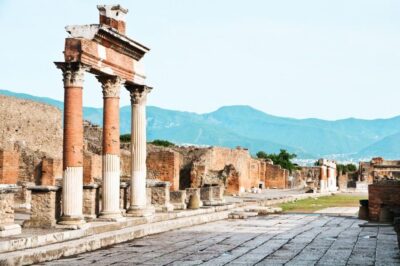

Pompeii & Amalfi Coast Full-Day Trip with Lunch
Read our review →Browse the lists this tour appears in