
Reviewed · POMPEII TOURS
Pompeii and Herculaneum led by an Archaeologist with private transport
Herculaneum gives you some of the best-preserved Roman homes anywhere, while Pompeii lets you walk an entire city grid frozen by Vesuvius. I like that an archaeologist guide turns broken walls and faded frescoes into clues about real Roman life, and that private Mercedes transport saves you from piecing together trains, taxis, and regional roads.
I also like the freedom of a private tour. Guides such as Daniela, Ivan, Alfredo, and Benedetto have been praised for adjusting the pace and answering questions. The catch is the $666.75 per-person price, which is steep unless you value door-to-door transport, a private group, and expert attention.
In This Review
- Key points to know before booking
- Why seeing Herculaneum and Pompeii together works
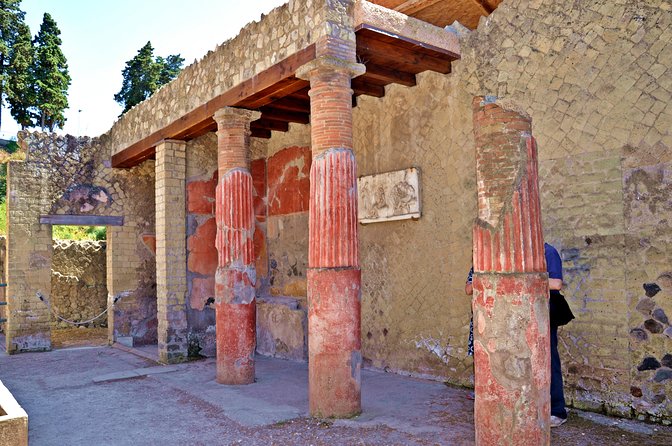
- Starting at Herculaneum’s preserved homes
- Baths, balconies, and houses with unusual plans
- Lunch and the move to Pompeii
- Pompeii’s forum, streets, and public buildings
- Baths, villas, and Pompeii’s theaters
- What the archaeologist adds
- Private transport and the real value of $666.75
- Timing, clothing, and useful preparation
- Who should book this experience?
- Should you book it?
- FAQ
- How long does the tour last?
- Where can pickup and drop-off take place?
- Is transportation private?
- Is an archaeologist included?
- Are Pompeii and Herculaneum entrance tickets included?
- Is lunch included?
- Is the tour offered in English?
- What should I wear and bring?
- Can people with mobility limitations participate?
- What is the cancellation policy?
Key points to know before booking
- Two famous ruins in seven hours: See Herculaneum and Pompeii in one day, with lunch time between the sites.
- A real archaeologist leads the walking tour: Expect context on Roman homes, religion, engineering, daily life, and the eruption of Vesuvius.
- Private Mercedes transport: Pickup and drop-off are available from accommodations, cruise ports, train stations, and airports in Naples, Salerno, Sorrento, and the Amalfi Coast.
- Herculaneum is smaller but remarkably preserved: Look for carbonized wood, painted rooms, baths, and the famous wooden partition.
- Pompeii provides the larger city experience: The forum, theaters, baths, villas, shops, and casts show how a whole Roman community worked.
- Plan for a long walking day: Wear sturdy shoes, carry water and sunscreen, and avoid flip-flops in summer.
Why seeing Herculaneum and Pompeii together works
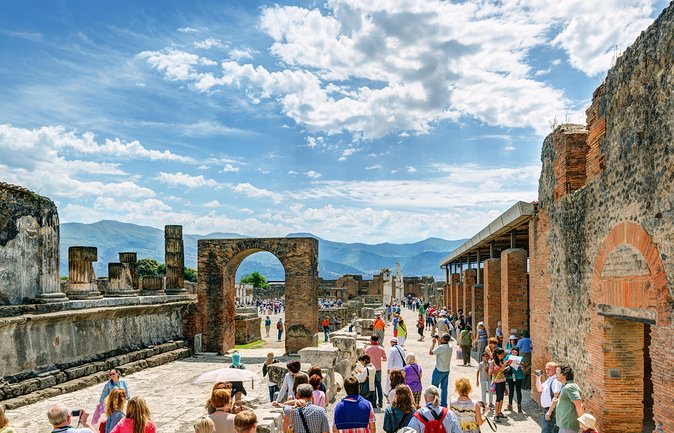
Pompeii and Herculaneum were both destroyed by Vesuvius in AD 79, but they offer very different visits. Pompeii is vast. You walk through streets, public buildings, private villas, baths, theaters, and commercial lanes spread across a large archaeological park.
Herculaneum is more compact and, in many ways, more intimate. Volcanic material preserved wooden doors, furniture details, wall decoration, and upper-floor elements that are less common at Pompeii. You can get a clearer sense of how a Roman house was arranged, from its entrance and atrium to its private rooms and courtyard.
I like the pairing because the sites correct each other. Pompeii shows you the scale of a Roman town. Herculaneum shows you the texture of domestic life. Seeing both also makes the eruption easier to understand. Pompeii was buried under falling ash and pumice, while Herculaneum was hit by extremely hot volcanic material and landslides. The different burial conditions helped preserve different things.
The seven-hour schedule is tight but workable with a guide who keeps you moving. This is not a slow, open-ended archaeological study day. You will see major highlights, but you should not expect to inspect every street or house at length.
More ways to see Pompeii:
- From Naples: Pompeii Ruins & Mount Vesuvius Day Tour
★ 4.3 · 11,459 reviews - Naples or Sorrento: Full-Day Pompeii and Mount Vesuvius Tour
★ 4.6 · 4,235 reviews - Pompeii & Mt.Vesuvius Day Tour from Naples with Pizza Lunch
★ 4.0 · 2,901 reviews
Starting at Herculaneum’s preserved homes
Pickup is offered from your accommodation, cruise port, train station, or airport in Naples, Salerno, Sorrento, and the Amalfi Coast. The usual plan begins at Herculaneum, where you meet the archaeologist at the ruins’ ticket office.
The Herculaneum visit is listed at about one hour, though the full sequence of stops means the actual time in and around the site can vary. The guide takes you through a concentrated run of houses and public buildings rather than simply leading you down the main street.
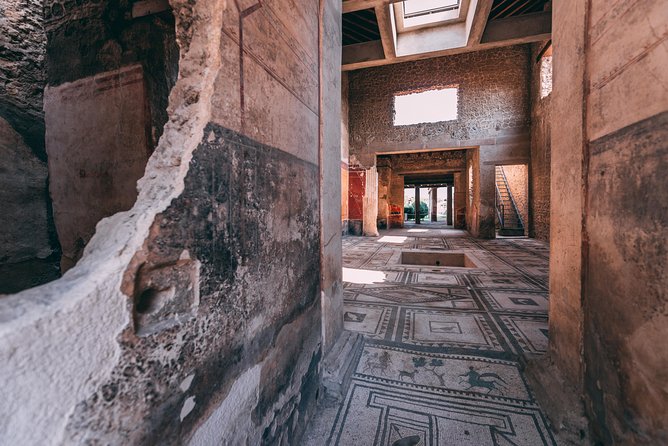
The House of the Deer takes its name from marble deer statues found in its peristyle, or colonnaded garden court. It helps introduce the wealthy side of Herculaneum, where a home could be designed around open-air space, sculpture, painted walls, and carefully framed views.
At the terrace of Marcus Nonius Balbus, you encounter one of the city’s major public benefactors. Balbus funded and restored public buildings, and the honors connected with his funeral altar show how civic generosity worked in Roman society. This is a useful stop because it moves the story beyond private villas and toward politics, status, and public life.
The College of the Augustales is linked to the worship of the emperor Augustus. Its exact civic function is still discussed, but it may have served as a religious headquarters or perhaps a local administrative center. An archaeologist can explain why ancient buildings are often interpreted through evidence rather than accepted as fully certain labels.
Baths, balconies, and houses with unusual plans
The Central Thermae, or public baths, date to around the beginning of the first century AD. Separate entrances served men and women, reflecting the organization of Roman bathing facilities. You can expect the guide to explain how baths functioned as social spaces, not just places to wash.
The Casa del Rilievo di Telefo is thought possibly to have belonged to Marcus Nonius Balbus. Its unusual feature is a private connection to the nearby Suburban Baths. That detail gives you a glimpse of privilege in practical terms: a prominent resident could access a major public facility directly from home.
The House of the Skeleton probably grew from three smaller buildings. Its name comes from human remains found in an upper room in 1831. The stop is a reminder that Herculaneum is not only a collection of elegant rooms. It also preserves evidence of the people who failed to escape.
At the House of the Black Salon, look for the monumental entrance and the carbonized remains of the doorposts and lintel. The dark, richly decorated hall belonged to one of the more luxurious homes in the town. The preserved wooden elements are especially important because they make the ancient building feel less like a stone shell.
The House of the Wooden Partition contains one of Herculaneum’s most important surviving wooden features. Its elegant partition remained in place after the eruption, giving you a rare view of how interior rooms could be separated with crafted timber rather than permanent masonry.
The Samnite House has an atrium ringed by a gallery with Ionic columns. Its room arrangement and frescoes reflect an older Samnite influence in the area. This is a good place to watch for the mixture of local traditions and Roman styles that shaped Campanian towns.
The House of the Beautiful Courtyard breaks from the more familiar atrium plan. Instead of a standard atrium, it has a courtyard with a staircase and stone balcony. The House of the Grand Portal, located near the center of the archaeological area, adds more colonnades, frescoes, and charred wooden remains.
The site names can blur together after several hours. I recommend asking your guide to pause at the features you find most interesting. Since this is a private activity, the pace can be adjusted more easily than on a large group outing.
Lunch and the move to Pompeii
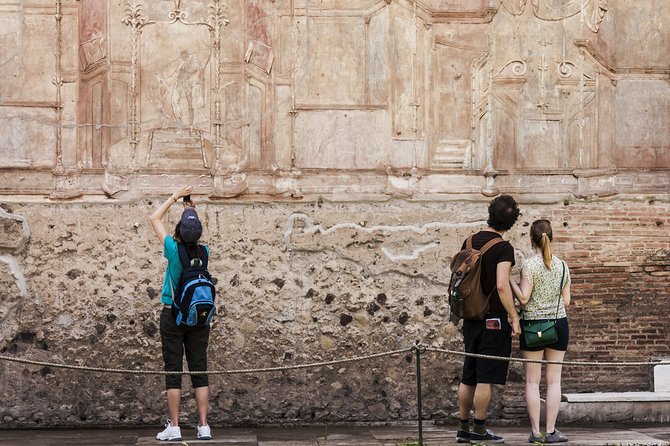
A lunch stop is offered between the two sites, but it is not obligatory. That flexibility matters. If you want a proper meal, the driver can recommend a place, and one guide specifically suggested a local winery for lunch. If you would rather maximize archaeological time, you can bring water and snacks or skip the stop.
The time available for lunch is one of the tour’s practical tradeoffs. A relaxed restaurant meal may reduce your time inside the ruins. On the other hand, seven hours of walking over uneven ancient streets is demanding, especially in summer. I would decide before the day begins whether food, shade, or extra site time matters most to you.
The private vehicle is a major convenience here. You do not need to navigate the Circumvesuviana railway or arrange separate taxis between the sites. A professional driver handles the road connections, while the guide focuses on the archaeology. Air conditioning is welcome after walking among exposed ruins.
More Herculaneum visits from Naples:
- Herculaneum: Skip-the-Line Guided Tour with Archaeologist
★ 4.8 · 3,439 reviews - Herculaneum Small Group Tour and Ticket With an Archaeologist
★ 5.0 · 994 reviews - Herculaneum: Skip-the-Line Entry Ticket with Audio Guide
★ 4.3 · 870 reviews - From Naples: Pompeii & Herculaneum with Archaeologist Guide
★ 4.8 · 665 reviews
Pompeii’s forum, streets, and public buildings
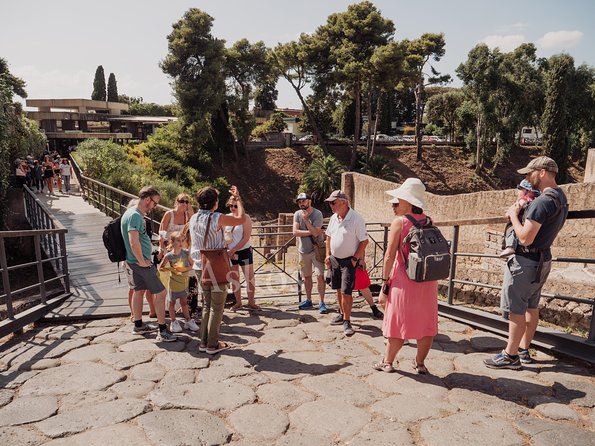
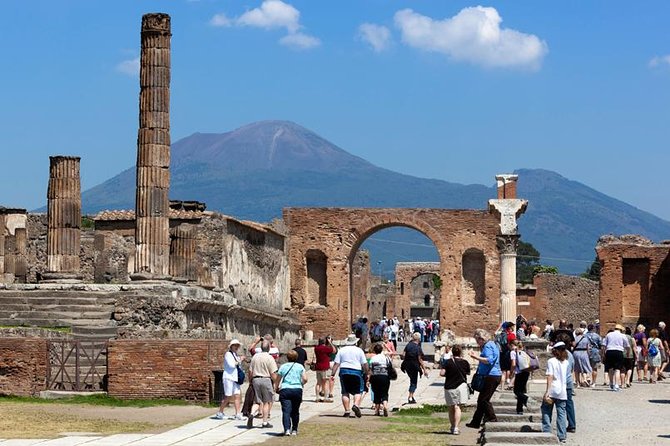
Pompeii usually receives the larger share of attention because the archaeological park covers so much ground. Your visit includes free time around the park and a guided route through some of its best-known monuments.
The Lupanar, Pompeii’s famous brothel, has small rooms and erotic paintings that offer a blunt look at one part of Roman commercial life. It can be crowded, so your guide’s timing may help you see it without losing too much time in a queue or packed doorway.
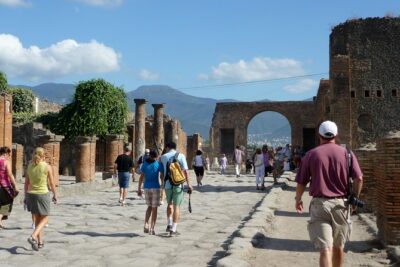
The Forum was the city’s main public square. From here, you can begin to understand Pompeii as an organized town rather than a random collection of ruins. Civic, commercial, religious, and political activity met in this central space.
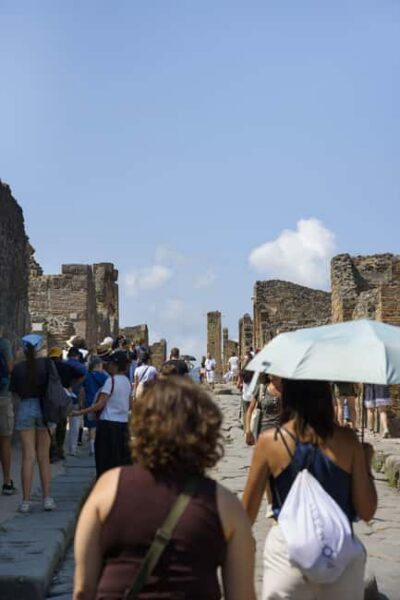
The main street provides another key piece of the puzzle. Ancient streets reveal how people moved through town and how homes, shops, fountains, and public buildings related to one another. Your guide can help you notice practical details that are easy to miss when you walk alone.
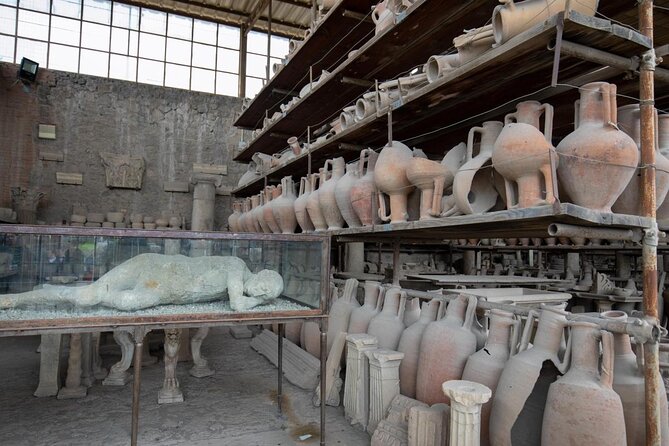
At the Granaries of the Forum, you can see marble tables, fountain basins, and casts of victims, including a dog and a tree. The casts are powerful but somber. Give yourself time to absorb what they represent rather than treating them as just another stop on a sightseeing route.
The Basilica was an open portico used for business and other public activity. It was not a church in the later Christian sense. That distinction is worth making because the word basilica changed meaning over time.
Baths, villas, and Pompeii’s theaters
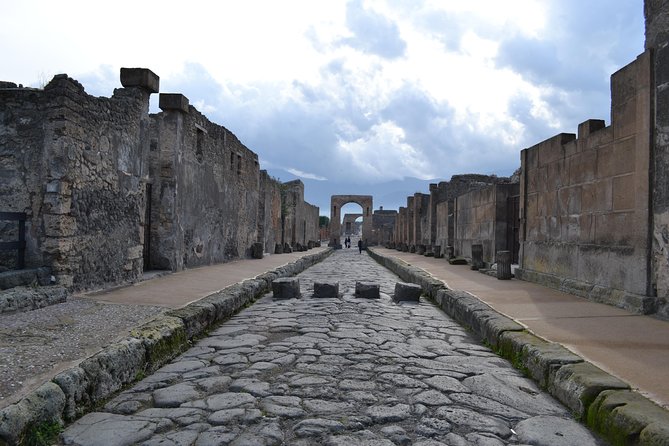
The Stabian Baths occupy a large area near the Brothel Lane, the Holconius crossroads, and Via Stabiana. They are considered the oldest thermal complex in Pompeii. Like the baths at Herculaneum, they show how much public life revolved around shared facilities.
The House of Menander is one of Pompeii’s most important residences, with substantial architecture, decoration, and contents. The name comes from an image of the Greek playwright Menander. A guide can connect the rooms to the tastes and status of the household that owned them.
The House of the Faun was among Pompeii’s largest and most impressive private residences. Its size alone helps you understand the gap between an elite domus and an ordinary urban home. It is also a useful counterpoint to the smaller houses at Herculaneum.
The Teatro Grande, or Large Theater, hosted major performances and is the most important theater included on the route. You also see the smaller theater, often called the Teatro Piccolo. Together they show that Pompeii supported different kinds of public entertainment and had purpose-built spaces for communal events.
The scheduled Pompeii route covers excellent highlights, but the site can easily occupy a full day by itself. You will not have the same freedom to wander every district as you would with a dedicated Pompeii-only visit. If your main goal is exhaustive coverage, book a longer single-site experience instead.
What the archaeologist adds
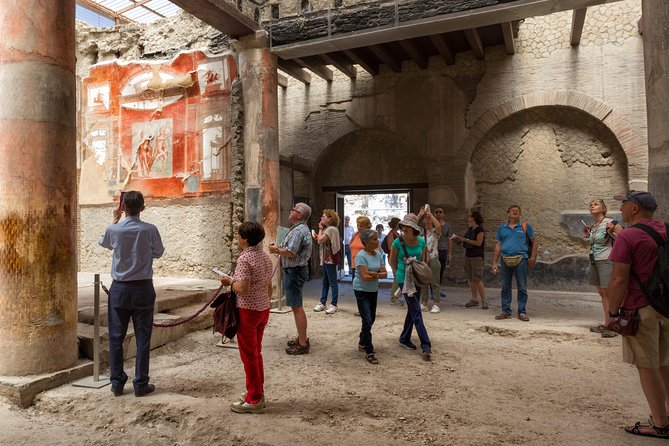
The guide is the heart of this experience. Names associated with the tour include Daniela, Ivan, Alfredo, Benedetto, John Carlos, Giacoma, and Mena. The precise guide depends on the date, but the service is built around an archaeologist rather than a guide who simply points out famous buildings.
That difference matters at Pompeii and Herculaneum. Without context, a painted room is just a painted room. With context, you can understand how the room fitted into a house, how decoration signaled wealth, and how Roman families used courtyards, baths, kitchens, shops, and reception areas.
The strongest guide experiences described by the operator include archaeologists who have worked at the sites for many years, including one guide who had helped uncover bodies, buildings, homes, and businesses. You should still confirm your guide’s credentials if that is important to you, but the tour’s main strength is the chance to ask questions and adjust the pace.
The private format also suits families. One guide received praise for keeping three teenagers interested, while another adapted the route for people with mobility limitations. That does not make the ruins fully accessible. Ancient streets are uneven, and the day involves substantial walking. It does mean you have more room to request pauses or spend longer at a particular feature.
Private transport and the real value of $666.75
At $666.75 per person, this is not a budget tour. The price makes more sense for a small private group than for one or two people comparing it with public transit and standard admission.
You are paying for a private Mercedes minivan, a professional driver, pickup and drop-off across a wide part of Campania, an archaeologist, and entrance arrangements for both sites. The vehicle is especially useful if you are staying on the Amalfi Coast or Sorrento, where transfers can consume much of the day.
The value improves as your group grows, particularly if several people can share the private vehicle and guide. Group discounts are offered, though the exact saving is not specified. For a couple, the cost is harder to justify unless comfort, time, and expert guidance are more important than keeping the day inexpensive.
There is a small point to clarify before booking. The tour information says admission tickets are included, while it also lists Herculaneum admission at 16 euros for adults and 2 euros for EU citizens aged 18 to 25. Ask the provider how the ticket cost is handled for your date and age group so there are no surprises.
Timing, clothing, and useful preparation
Allow about seven hours from pickup to drop-off. The day may begin at your accommodation or transport hub and finish there after Pompeii. Cruise passengers should share the ship’s arrival and departure times clearly. One booking was adjusted because a ship arrived later than usual, and the group still returned with time to spare, but you should never assume every schedule can be changed.
Wear comfortable shoes with good support. This advice is not decoration. You will walk over ancient paving and uneven surfaces at two large outdoor sites.
Bring water, sunglasses, and sunscreen. In summer, flip-flops are specifically discouraged. A small snack is sensible if you plan to skip lunch, though personal food and meals are not included.
The activity is offered in English and is private, meaning only your group participates. Service animals are allowed, and most people can take part, but the combination of heat, walking, and rough surfaces should be considered carefully if anyone in your party has limited stamina.
Free cancellation is available up to 24 hours before the start time. Cancellations or changes made inside that window are not accepted for a refund.
Who should book this experience?
I would choose this tour if you want both sites in one day and do not want to manage transport between them. It is particularly useful from a cruise port, Sorrento, Salerno, or the Amalfi Coast, where private pickup removes a lot of friction.
It also suits you if the difference between a house, a bath, a forum, and a theater matters. The archaeologist can connect small details, such as a carbonized doorpost or a private bath entrance, to larger questions about Roman society.
Families and mixed-age groups may appreciate the private pace. So may anyone who wants to ask many questions or linger at the House of the Faun, the theaters, or Herculaneum’s wooden features.
I would not choose it if your budget is tight, you prefer independent wandering, or Pompeii alone is your main goal. Seven hours is a strong introduction to two sites, not enough time for every corner. You should also expect a demanding walking day despite the comfortable vehicle.
Should you book it?
Book this Pompeii and Herculaneum tour if you value expert interpretation and easy transport more than low cost. The combination of a private Mercedes, pickup across Campania, and an archaeologist guide gives you a clear, efficient way to see two major sites.
The price is high, but the format earns its keep for families, cruise passengers, and small groups splitting the cost. Bring water, wear proper shoes, decide how much lunch time you want, and confirm the ticket details before paying. For a focused first visit to Vesuvius’s buried towns, this is a strong choice.
FAQ
How long does the tour last?
The tour lasts approximately seven hours, including transportation, site visits, and the optional lunch break.
Where can pickup and drop-off take place?
Pickup and drop-off are available from accommodations, cruise ports, train stations, and airports in Naples, Salerno, Sorrento, and the Amalfi Coast.
Is transportation private?
Yes. Transportation is provided by private Mercedes minivan with a professional driver, and only your group participates.
Is an archaeologist included?
Yes. The tour includes guidance and assistance for the entire tour with an archaeologist guide.
Are Pompeii and Herculaneum entrance tickets included?
The included services list entrance fees for Herculaneum and Pompeii, including Pompeii Express tickets. The information also lists Herculaneum admission as 16 euros for adults and 2 euros for EU citizens aged 18 to 25, so confirm the exact ticket arrangement when booking.
Is lunch included?
No. Meals are not included. A lunch stop is offered between Herculaneum and Pompeii, but you are not required to stop.
Is the tour offered in English?
Yes. The experience is offered in English.
What should I wear and bring?
Wear comfortable shoes. In summer, do not wear flip-flops. Sunglasses, sunscreen, and water are recommended.
Can people with mobility limitations participate?
Most people can participate, and the private format allows the guide to be patient and helpful with some mobility limitations. The ruins still involve walking on uneven ancient surfaces.
What is the cancellation policy?
You can cancel up to 24 hours before the start time for a full refund. Cancellations or changes made less than 24 hours before the start time are not accepted for a refund.
Just added around Naples
- Full-Day Tour of the Amalfi Coast and Pompeii from Naples★ 4.5 · 3 reviews
- The Ultimate Neapolitan Cooking Class with Local★ 5.0 · 3 reviews
- Naples: Old City Center Street Food Tour with Spritz★ 4.7 · 3 reviews
- Visit in Pompeii – Naples Private Tour with Ada★ 5.0 · 3 reviews
- Transfer from Naples to Sorrento or viceversa★ 5.0 · 3 reviews
- Naples: National Gallery of Capodimonte Tour★ 5.0 · 3 reviews
- Visit 2 wine producers with tasting and transportation included★ 5.0 · 3 reviews
- Naples: Mozzarella experience★ 5.0 · 3 reviews
Pompeii Tours, compared.
Pompeii & Mt.Vesuvius Day Tour from Naples with Pizza Lunch
Read our review →
Pompeii & Mt Vesuvius All-Inclusive Small Group w/ Lunch
Read our review →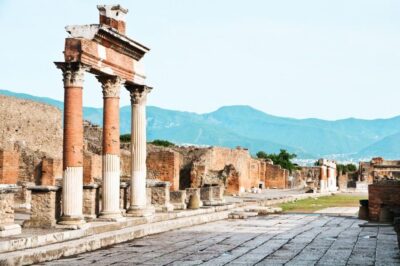
Pompeii & Amalfi Coast Full-Day Trip with Lunch
Read our review →Browse the lists this tour appears in