
Reviewed · POMPEII TOURS
Pompeii and Herculaneum Private Walking Tour with an Archaeologist
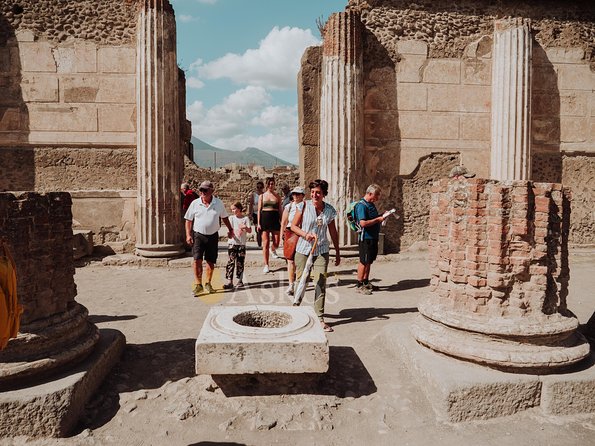
Pompeii and Herculaneum tell the same disaster story in very different ways. Pompeii gives you broad streets, public buildings, theaters, and famous houses. Herculaneum feels smaller and more intimate, with carbonized wood, vivid rooms, and an unusually close look at domestic life. Having an archaeologist guide connect the two sites makes this far more useful than wandering with a map.
I especially like the private format, which lets you ask questions and adjust the pace. I also like the focus on ordinary Roman life: baths, shops, homes, building materials, decoration, and the practical workings of a Roman town. The main caution is cost. At $597.36 for a group of up to 15, this is good value for a larger family or group, but expensive for only two people. Tickets, transport, food, and drinks are extra.
In This Review
- Key points to know before booking
- Why seeing Herculaneum before Pompeii works so well
- Herculaneum’s houses show Roman life in close-up
- Baths, painted rooms, and clever house plans
- Pompeii’s Porta Marina entrance and main street
- Public buildings reveal how Pompeii functioned
- What an archaeologist adds to the walk
- Cost, tickets, and the real value
- Who should book this private Pompeii tour
- Should you book it?
- FAQ
- How long does the Pompeii and Herculaneum private tour last?
- Where does the tour begin?
- Where does the tour end?
- Are entrance tickets included?
- Is transportation included?
- Is this a private tour?
- What should I wear?
- Is the tour offered in English?
Key points to know before booking
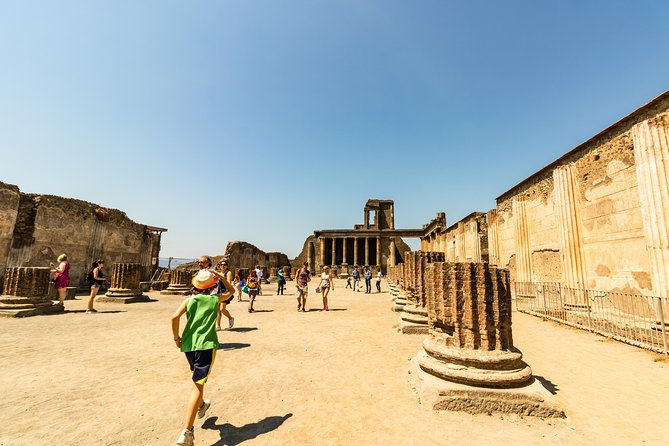
- Two cities, two different moods: Herculaneum offers compact, detailed houses, while Pompeii supplies the grand civic scale.
- A true private tour: Only your group takes part, so you can ask questions and request a slower or faster pace.
- The guide is the main advantage: Archaeologists including Mena, Vincenzo, Ivan, Sylvia, and Giancarlo have received especially strong praise for making the ruins understandable.
- Plan for substantial walking: Comfortable shoes are required, and flip-flops are specifically discouraged.
- Budget beyond the tour fee: Herculaneum and Pompeii entrance tickets, train or other transport, and lunch are not included.
- Book early: The experience is booked about 106 days ahead on average, a useful warning for fixed cruise or holiday schedules.
Why seeing Herculaneum before Pompeii works so well
The usual plan begins at the Herculaneum Archaeological Park. From Naples, you take the Circumvesuviana train to Ercolano, a trip of about 30 minutes, then walk roughly 10 minutes to the ruins. The tour description allows for a quick lunch break if needed, but you should not treat lunch as a full restaurant stop. Bring a plan and allow enough time for the transfer.
The meeting point is the ticket office of the Herculaneum ruins, at Via dei Papiri Ercolanesi. If you drive, there is an unguarded parking area near Via Pignalver. By train, use the Circumvesuviana station at Corso Resina 1, then walk to the entrance.
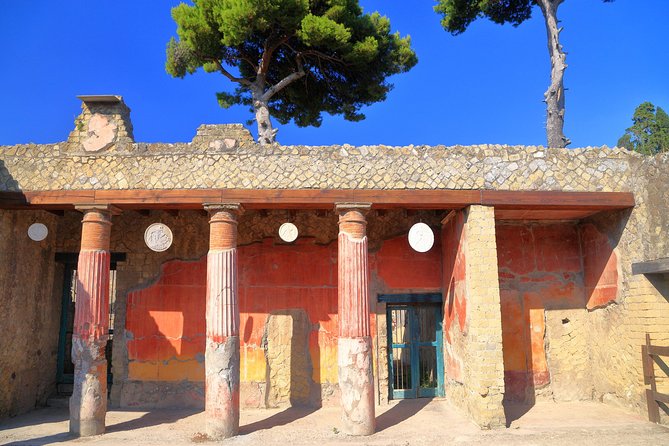
Starting here gives you a compact introduction to the eruption and Roman domestic life. Herculaneum was buried under volcanic material from Mount Vesuvius, and its remains include an unusual amount of carbonized wood. Doorposts, lintels, partitions, and other wooden elements help you picture Roman buildings as working structures, not just stone shells.
After about an hour at the main park, the guide moves through a series of houses and public buildings. The listed timing of roughly 10 minutes per small stop is an outline, not a stopwatch. With a private guide, you can spend longer on a room that catches your interest, though the five-and-a-half-hour schedule means you cannot linger everywhere.
More ways to see Pompeii:
- From Naples: Pompeii Ruins & Mount Vesuvius Day Tour
★ 4.3 · 11,459 reviews - Naples or Sorrento: Full-Day Pompeii and Mount Vesuvius Tour
★ 4.6 · 4,235 reviews - Pompeii & Mt.Vesuvius Day Tour from Naples with Pizza Lunch
★ 4.0 · 2,901 reviews
Herculaneum’s houses show Roman life in close-up
The House of the Deer takes its name from marble deer and stag statues found in its peristyle. That detail gives the place an immediate human touch. You are not only looking at walls and columns. You are seeing the decorative choices of a wealthy household and the way a garden courtyard helped shape the home.
At the Terrace of M. Nonius Balbus, the guide can introduce one of Herculaneum’s major benefactors. Balbus restored and built public structures, and after his death the town honored him with a funeral altar and a long inscription. This is a useful stop for understanding how public generosity, status, and civic pride worked in Roman towns.
The College of the Augustales is linked to the cult of Emperor Augustus. It may also have served as a local council building. Its uncertain use is part of the appeal. Archaeology often gives you strong clues rather than one neat answer, and a trained guide can explain the difference between evidence and theory.
Casa del Rilievo di Telefo may have belonged to Marcus Nonius Balbus, the same local figure connected with the terrace. Its private access to the neighboring Suburban Baths is especially interesting. It shows how a well-placed household could connect directly with a major public amenity.
The House of the Wooden Partition is important for its elegant carbonized wooden screen. You might normally think of Roman interiors as marble and painted plaster, but preserved wood changes that picture. The House of the Skeleton is named for human remains found in an upstairs room in 1831, and it adds a more sobering note to the walk.
Baths, painted rooms, and clever house plans
The Central Baths date from around the beginning of the first century AD. Men’s and women’s sections had separate entrances, reflecting the organized nature of Roman bathing. The guide can help you read the spaces as a social system, not just a collection of rooms.
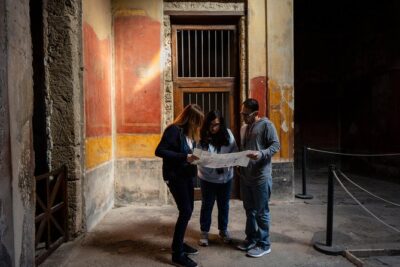
The House of the Black Salon is one of Herculaneum’s more luxurious mansions. Its monumental entrance still preserves carbonized doorposts and a lintel. These details are easy to miss when you are walking alone, but they are exactly the sort of evidence an archaeologist can point out.
Casa Sannitica has a striking atrium surrounded by a gallery with Ionic columns. Its layout reflects an older Samnite arrangement, while its frescoes show how homes changed over time. Casa del Bel Cortile is unusual for having a courtyard with a stairway and stone balcony instead of a standard atrium.
The House of the Grand Portal brings together many of Herculaneum’s recurring pleasures: colonnades, frescoed rooms, and charred wooden remains. You get a strong sense of how much Roman architecture depended on color, timber, plaster, and carefully framed views.
Herculaneum is smaller than Pompeii, but that does not make it a throwaway first stop. Its compact plan and preserved interiors can be easier to understand. You see homes at close range, then carry that knowledge into Pompeii, where the scale grows much larger.
Pompeii’s Porta Marina entrance and main street
The second site is Pompeii Archaeological Park. The stated meeting point is the main entrance called Porta Marina Superiore, where the guide is expected to hold an Askos Tours sign. The tour ends inside the Pompeii ruins, so plan your onward journey from the archaeological area rather than back at the starting point.
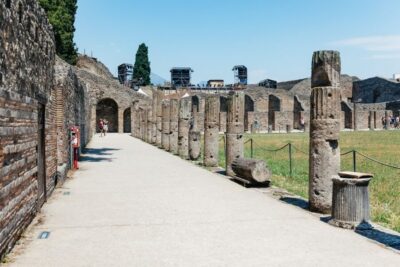
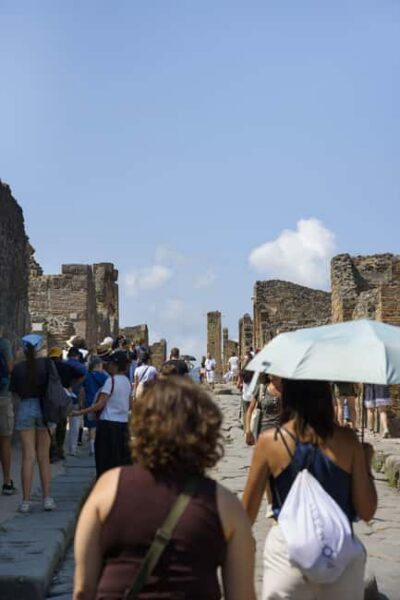
Pompeii demands more physical effort. The streets cover a much larger area, and the ancient paving can be uneven. Wear supportive shoes, use sunscreen, and bring sunglasses. The advice to avoid flip-flops is practical, not fussy.
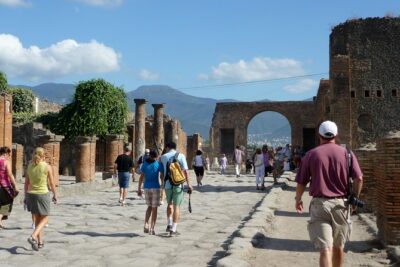
The walk includes the main street and the Lupanar, Pompeii’s most famous brothel. The Lupanar is a memorable stop because it reveals a commercial side of Roman life that grand temples and villas can hide. Its place in the street network also helps you understand how homes, businesses, and public spaces fit together.
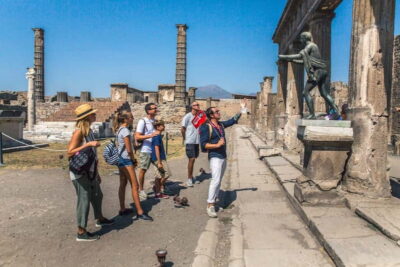
At the Forum, you reach the city’s main square. This was the civic center, and it gives the tour a useful sense of scale. After seeing private courtyards in Herculaneum, you can now see where public business, religion, and commerce met in Pompeii.
The Forum Granaries hold marble tables and fountain basins that once decorated house entrances. They also contain casts of eruption victims, including a dog and a tree. This is likely to be one of the more emotionally difficult stops, so families with children may want to prepare them for the human remains and the serious subject of the eruption.
More Herculaneum visits from Naples:
- Herculaneum: Skip-the-Line Guided Tour with Archaeologist
★ 4.8 · 3,439 reviews - Herculaneum Small Group Tour and Ticket With an Archaeologist
★ 5.0 · 994 reviews - Herculaneum: Skip-the-Line Entry Ticket with Audio Guide
★ 4.3 · 870 reviews - From Naples: Pompeii & Herculaneum with Archaeologist Guide
★ 4.8 · 665 reviews
Public buildings reveal how Pompeii functioned
The Basilica was an open portico used by merchants and for other civic activity. It was not a church in the later Christian sense. A guide can make that distinction clear and explain how the building helped organize business and legal life.
The Stabian Baths are the oldest thermal complex in Pompeii. The site covers a large area near the Brothel Lane, the Holconius crossroads, and Via Stabiana. Seeing these baths after Herculaneum’s Central Baths lets you compare two versions of Roman public bathing and town planning.
The House of the Faun is one of Pompeii’s largest private residences. Its size alone says something about wealth and social rank. The House of Menander is another major domestic highlight, known for its architecture, decoration, and contents. Together, the two houses show how private power could occupy an enormous place within a Roman city.
The Teatro Grande was Pompeii’s main theater. You will also see the smaller Teatro Piccolo, often called the small theater. The contrast is useful: one space served larger performances, while the other offered a more compact setting. These theaters remind you that entertainment was a central part of city life, not an occasional luxury.
What an archaeologist adds to the walk
The best part of this tour is not simply having someone point out famous rooms. It is having someone explain how the evidence fits together. The strongest guide experiences described for this tour involved explanations of the eruption, houses and businesses, construction materials, decoration, engineering, and Roman culture.
Mena is praised for combining archaeological expertise with an engaging manner. Vincenzo is described as especially strong at explaining both Pompeii and Herculaneum. Ivan has led groups away from the busiest routes while discussing engineering and daily life, a useful approach when the main streets fill with tour groups.
Sylvia has worked at both sites and is described as able to keep adults and children involved. Giancarlo has been especially patient with children’s questions. Other named guides include Raffaele Romano, Giovanni, Paola, Marilee or Marili, and Alessandra. Guide assignments can change, so you should not book on the assumption that one particular person will lead your visit unless the company confirms it.
The private setup matters most when your group has mixed interests. Children can ask basic questions without holding back. A serious student can ask about construction or chronology. You can also spend more time on a house and less time on a stop that does not interest you.
One caution: the guide’s skill may vary in delivery even when the archaeological background is strong. One account found the presentation somewhat formulaic and wished for more explanation during the walks between stops. That is a fair limitation to keep in mind. A private tour gives you the chance to ask for more conversation as you move.
Cost, tickets, and the real value
The listed price is $597.36 per group of up to 15 people. That price covers the private tour and guidance from an archaeologist, but not entry tickets, transport, meals, or drinks. Herculaneum tickets are listed at 16 euros for adults and 2 euros for EU citizens aged 18 to 25. Pompeii entry is also extra, with the listing referring to the Pompei Express ticket.
For two people, the cost is a major splurge. For a family of four, a group of seven, or a larger party sharing the fee, the calculation looks much better. You are paying for private attention, not merely admission, and that can make a large difference at sites where a map or audio guide leaves you unsure what matters.
You should also budget for the Circumvesuviana train or another way to reach the ruins. The tour includes no transportation. A quick lunch break may be possible, but food and drinks are your responsibility.
Buy tickets in advance if you can. One experience was slowed by confusion over queue arrangements, and the advice from that problem is plain: do not assume the guide fee automatically includes skip-the-line access or advance ticketing. Ask Askos Tours exactly how your entry works before the day of the visit. This is particularly important if you are traveling on a tight cruise schedule.
The tour is advertised at about five hours and 30 minutes, though one family spent more than seven hours with a guide. Do not count on the longer day. Confirm the expected duration if you need to catch a train, meet a driver, or return to a ship.
Who should book this private Pompeii tour
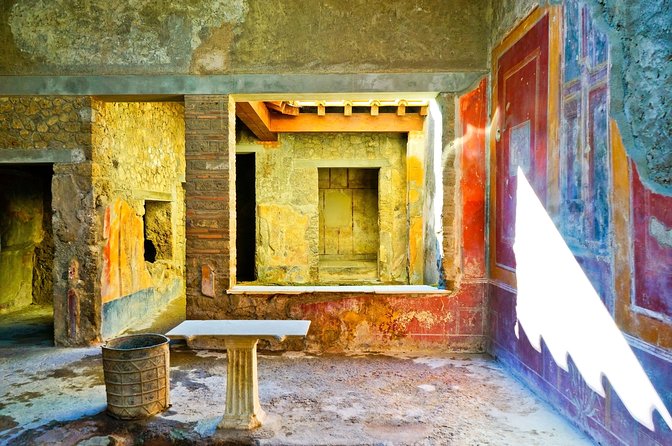
I would choose this for families, multigenerational groups, and anyone who wants context rather than a quick photo stop. The sites can feel overwhelming on your own. A guide helps you connect a wooden partition, a bath entrance, a painted room, and a public square into a picture of how the town worked.
It is also a strong choice for anyone with a serious interest in Roman architecture, urban planning, archaeology, or the eruption of Vesuvius. The guide’s ability to answer questions is the reason to pay for private service.
I would think twice if you are traveling alone or as a couple on a strict budget. The price per person drops sharply as your group grows. I would also reconsider if you dislike walking, hot sun, uneven ancient streets, or a schedule that moves through many sites in one day.
Askos Tours has a 4.9 rating from 77 reviews and is recommended by 97 percent of customers in the supplied figures. The praise centers on the archaeologist guides, personal attention, flexibility, and help with transit problems. The weaker points are clear meeting instructions, ticket expectations, and the possibility of a formulaic presentation.
Should you book it?
Book this tour if you want both Pompeii and Herculaneum in one serious half-day, and if your group can share the private fee. The archaeologist is the reason to choose it. You will get more than names and dates, especially at the houses, baths, theaters, and eruption remains that are easy to pass without context.
Before paying, confirm the guide language, ticket arrangements, exact meeting instructions, transport plan, and expected finish time. If those details fit your day, this is a strong way to see two remarkable sites without trying to make sense of them alone. If you are watching every euro, use the admission tickets and explore independently, then spend your savings on extra time at whichever site interests you most.
FAQ
How long does the Pompeii and Herculaneum private tour last?
The planned duration is approximately five hours and 30 minutes. The actual day can vary, so confirm the expected finish time if you have a fixed onward schedule.
Where does the tour begin?
The usual starting point is the ticket office of the Herculaneum ruins at Via dei Papiri Ercolanesi, 80056 Ercolano. The itinerary also identifies the Herculaneum train station at Corso Resina 1, about a 10-minute walk away.
Where does the tour end?
The tour ends inside the Pompeii ruins at Via Villa dei Misteri. The Pompeii meeting point is the Porta Marina Superiore entrance.
Are entrance tickets included?
No. Herculaneum entry tickets and the Pompei Express entry tickets are not included. Herculaneum admission is listed as 16 euros for adults and 2 euros for EU citizens aged 18 to 25.
Is transportation included?
No. Any transportation to the sites is extra. The planned transfer to Herculaneum uses a train for about 30 minutes, followed by a walk of about 10 minutes.
Is this a private tour?
Yes. Only your group participates, with a maximum group size of 15 people.
What should I wear?
Wear comfortable walking shoes. Flip-flops are not recommended. Sunglasses and sunscreen are also suggested.
Is the tour offered in English?
Yes. English is the listed tour language.
More Walking Tours in Naples
- Naples: Street Food Walking Tour with Local Guide
★ 4.8 · 4,256 reviews - Naples Spanish Quarters Walking Tour Street Art, Folklore & Sweet
★ 5.0 · 797 reviews - Naples: Old Town Guided Walking Tour
★ 4.8 · 553 reviews - Naples: Panoramic Walking Tour with Funicular
★ 4.8 · 543 reviews
Just added around Naples
- Full-Day Tour of the Amalfi Coast and Pompeii from Naples★ 4.5 · 3 reviews
- The Ultimate Neapolitan Cooking Class with Local★ 5.0 · 3 reviews
- Naples: Old City Center Street Food Tour with Spritz★ 4.7 · 3 reviews
- Visit in Pompeii – Naples Private Tour with Ada★ 5.0 · 3 reviews
- Transfer from Naples to Sorrento or viceversa★ 5.0 · 3 reviews
- Naples: National Gallery of Capodimonte Tour★ 5.0 · 3 reviews
- Visit 2 wine producers with tasting and transportation included★ 5.0 · 3 reviews
- Naples: Mozzarella experience★ 5.0 · 3 reviews
Pompeii Tours, compared.
Pompeii & Mt.Vesuvius Day Tour from Naples with Pizza Lunch
Read our review →
Pompeii & Mt Vesuvius All-Inclusive Small Group w/ Lunch
Read our review →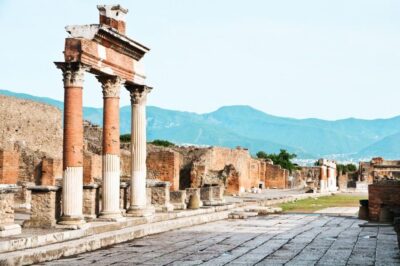
Pompeii & Amalfi Coast Full-Day Trip with Lunch
Read our review →Browse the lists this tour appears in