
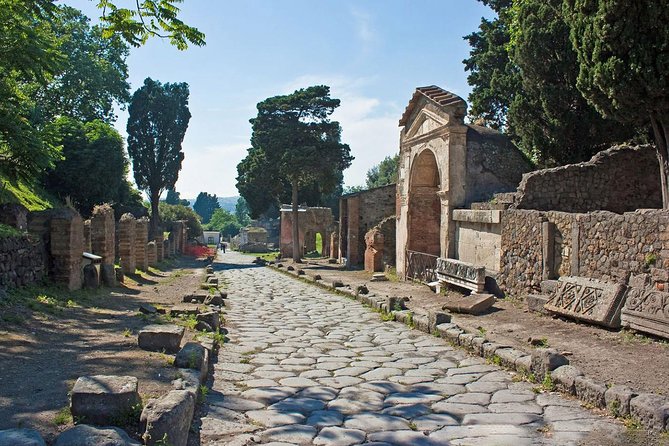
Reviewed · HERCULANEUM TOURS
Skip the Line Herculaneum Ruins Ticket
Herculaneum feels more intimate than Pompeii. Volcanic mud and dust sealed its homes, mosaics, furniture, and wall paintings, leaving a Roman town that often feels less like a wide-open ruin and more like a place where daily life simply stopped. With this $25 timed entry ticket, you can explore independently for about four and a half hours.
I like the freedom to set your own pace, and I like that the site’s best details are ordinary ones: a bakery, a courtyard, a wooden room divider, and a bathhouse. The main catch is the skip-the-line promise. At quiet times, buying a regular ticket may be just as fast, and some visitors have had trouble getting an electronic voucher scanned at the entrance.
In This Review
- Key points to know before you book
- Why Herculaneum feels different from Pompeii
- Getting to the entrance at Corso Resina
- Start with the House of Neptune and Amphitrite
- Pause at the Terrace of M. Nonio Balbo
- Explore the House of the Relief of Telephus
- Look closely at the House of the Wooden Partition
- See the House of the Deer
- Visit the College of the Augustales
- Find the House of the Black Salon
- Do not miss the House of the Skeleton
- Compare the Samnite House and Fine Courtyard
- See the Central Thermae
- Finish with the grand doorways and the Salon of the Boat
- How much time should you allow?
- Is the $25 ticket good value?
- Who should book this experience?
- Should you book the Herculaneum ticket?
- FAQ
- Where does the Herculaneum ticket experience start?
- What time does the experience start?
- How long does the visit last?
- Is a guide included?
- Is transportation included?
- What can I see inside Herculaneum?
- Can children participate?
- Are service animals allowed?
- Can I cancel for a full refund?
Key points to know before you book
- Herculaneum is unusually well preserved: Expect vivid mosaics, painted rooms, courtyards, and domestic details.
- This is an independent visit: The ticket includes entry only, not a guide, transport, food, drinks, or an audio tour.
- The $25 price buys convenience, not a full tour: Its value depends on how long the entrance queue is on your chosen day.
- Allow up to 4 hours 30 minutes: You can see the main route faster, but a slower visit gives the houses and baths time to make sense.
- The House of the Skeleton and House of Neptune are essential stops: Plan your route around these and the Central Thermae.
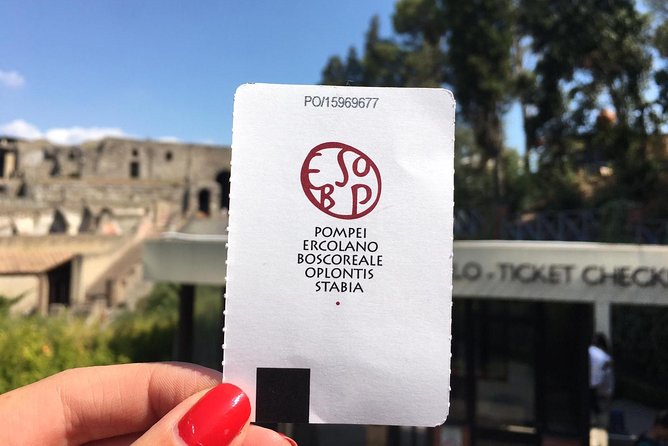
- Check your email twice: You receive a Viator voucher first, followed by the actual site entry ticket.
Why Herculaneum feels different from Pompeii
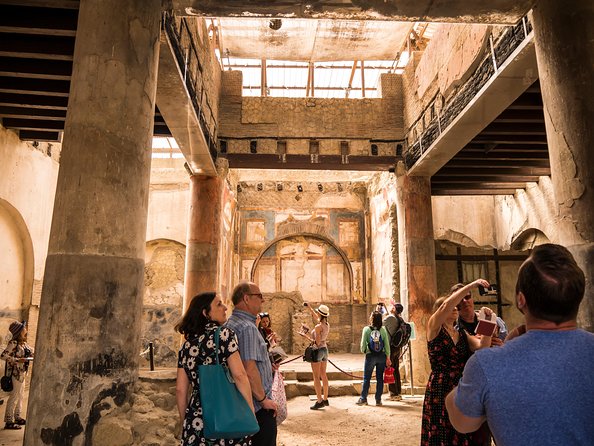
Herculaneum was a Roman seaside town buried by the eruption of Mount Vesuvius in AD 79. Pompeii was covered mainly by ash and pumice, while Herculaneum was overwhelmed by hot volcanic mud and debris. That difference helped preserve more of the town’s upper floors, woodwork, mosaics, and wall decoration.
You will not simply walk past broken walls. In several houses, you can see how rooms connected, how courtyards brought light into the home, and how wealthy families decorated their private spaces. The site is smaller than Pompeii, which makes it easier to cover in one visit, but it still rewards a slow eye.
I especially like Herculaneum for its human scale. Pompeii can feel like a vast archaeological city. Herculaneum feels like a neighborhood. You move from a grand house to a bathhouse, then into a narrow street where small signs of Roman life remain in place.
This ticket gives you admission at a selected time. You then explore without a guide. That arrangement suits you if you enjoy reading signs, using a guidebook, or following an audio tour on your phone. An audio guide has been useful for some visitors, especially because it can combine spoken explanations with written material.
More Herculaneum visits from Naples:
- Herculaneum: Skip-the-Line Guided Tour with Archaeologist
★ 4.8 · 3,439 reviews - Herculaneum Small Group Tour and Ticket With an Archaeologist
★ 5.0 · 994 reviews - Herculaneum: Skip-the-Line Entry Ticket with Audio Guide
★ 4.3 · 870 reviews
Getting to the entrance at Corso Resina
The meeting point is at the excavations on Corso Resina 187 in Ercolano. The site is near public transportation, and Herculaneum is accessible by train from Naples. From the station, the archaeological area is about one kilometer away, so plan for a walk if you are carrying luggage or traveling in strong heat.
The scheduled start time provided for this experience is 10:00 am. Your actual entry depends on the time selected when you book, so check the ticket in your email rather than relying only on the first voucher.
This is a practical place to slow down before entering. Confirm that you have the correct site entry ticket, not just the booking confirmation. A printed copy may help, but keep the ticket on your phone as well. Electronic barcodes have not always scanned smoothly at the gate, and some people have had to wait while staff processed the voucher manually.
That issue matters because the advertised convenience is mainly about getting through the entrance. There is not always a clearly marked separate desk for skip-the-line visitors. On a quiet morning, the regular ticket queue may be negligible. On a busy day, a timed ticket may still give you useful peace of mind.
Start with the House of Neptune and Amphitrite
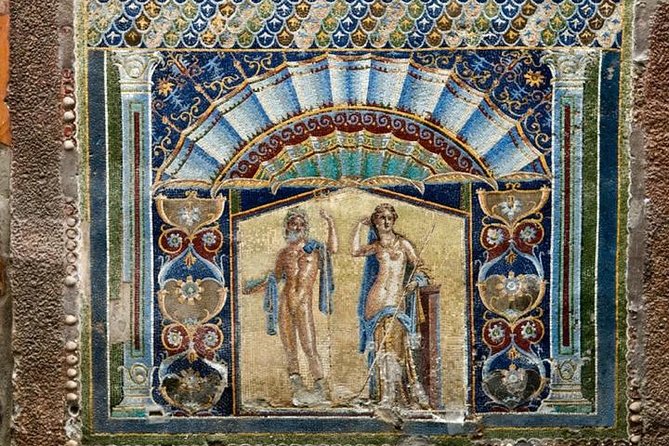
Make the House of Neptune and Amphitrite one of your first serious stops. Its mosaic decoration is among Herculaneum’s memorable sights, with colored tiles arranged in lively patterns around the room.
The house helps you understand why Herculaneum can feel so personal. You are looking at a private Roman residence rather than only public monuments. The decorative work suggests wealth and taste, while the layout offers clues about how the household was organized.
Allow about 15 minutes here, though you may want longer if the rooms are open and the light is good. This is one of the places where an audio guide or book adds real value because the artwork is easier to appreciate when you know what you are seeing.
Pause at the Terrace of M. Nonio Balbo
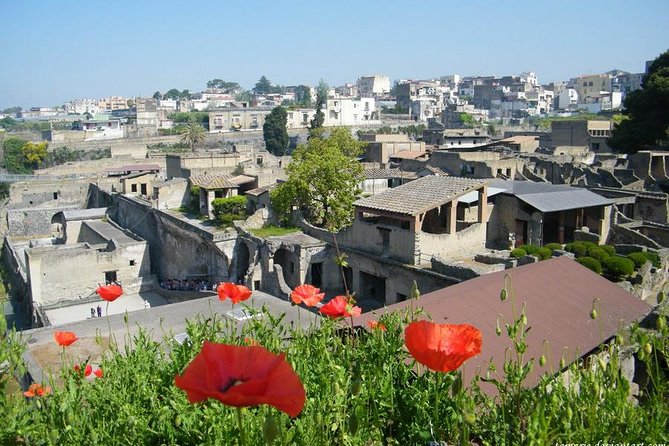
The Terrace of M. Nonio Balbo is a brief stop, listed at about 10 minutes. It offers a change from the enclosed houses and helps break up the indoor route.
You will see the terrace associated with M. Nonio Balbo, a prominent figure honored in the ancient town. The stop is not as visually dense as the decorated houses, but it gives the visit a wider civic context.
Use it as a point to check your map and decide how much time you have left. Herculaneum is easier to navigate than Pompeii, but a basic route plan still helps because opening access to individual buildings can vary.
A few more Naples trips worth weighing up
- Mount Vesuvius: Skip-the-Line Ticket and Smart Digital Guide
★ 4.2 · 2,780 reviews - From Naples: Pompeii Skip-the-Line Entry Ticket and Tour
★ 4.4 · 2,753 reviews - Pompeii: Skip-the-Line Entry Ticket with Audio Guide or Tour
★ 4.1 · 1,364 reviews - From Naples: Pompeii Guided Tour with Skip-the-Line Tickets
★ 4.8 · 1,171 reviews
Explore the House of the Relief of Telephus
The House of the Relief of Telephus is another substantial residence, with around 15 minutes worth of material to inspect. Its name refers to a relief connected with Telephus, a figure from Greek mythology.
This house shows the cultural world of Roman Herculaneum. Roman homes were not plain living spaces. Mythological subjects, carefully arranged decoration, and architectural display all helped communicate the owner’s education and status.
You may find some rooms more rewarding than others depending on what is open. Do not rush simply because the doorway looks modest. In Herculaneum, the best detail is often inside, beyond the first wall.
Look closely at the House of the Wooden Partition
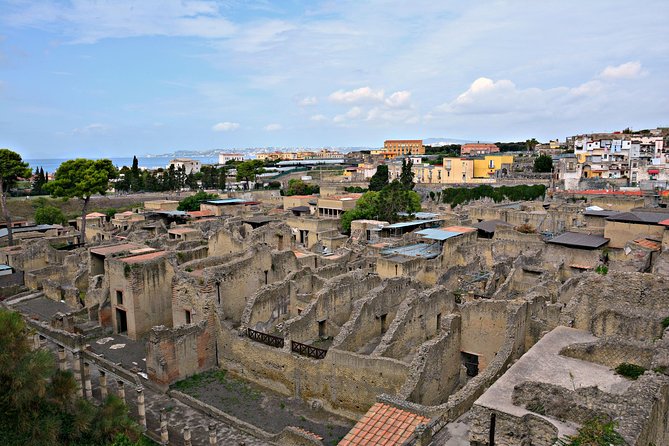
The House of the Wooden Partition is one of the more distinctive domestic stops. Its wooden partition gives you a rare sense of the materials used in an ancient home.
Stone survives easily in archaeological sites. Wood usually does not. That makes this house especially useful for imagining Roman interiors as lived spaces rather than bare masonry. A partition could divide a room, control movement, or provide privacy, giving you a glimpse of practical household design.
Plan on about 15 minutes here. Look for the relationship between the wooden feature and the surrounding rooms. The value of this stop is not only visual. It helps you picture doors, furniture, fittings, and room divisions that have vanished elsewhere.
See the House of the Deer
The House of the Deer is one of the larger and more famous homes on the route. Give it around 15 minutes, or longer if you are interested in Roman domestic architecture.
The house is associated with decorative deer sculptures and offers another look at a wealthy residence. Its layout and ornamental features show how Roman owners used homes for comfort, display, and entertaining.
This is a good stop for comparing with the House of Neptune and Amphitrite. Instead of treating each house as an isolated ruin, notice how they repeat certain ideas: courtyards, decorated rooms, planned entrances, and careful views through the building.
Visit the College of the Augustales
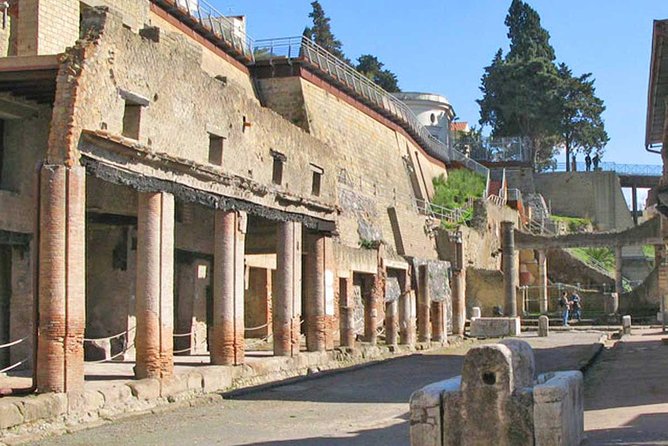
The College of the Augustales shifts the focus from private homes to religious and civic life. The Augustales were connected with the imperial cult, and this building gives you a glimpse of how public loyalty and religious practice worked in Roman society.
Allow about 15 minutes. The space is less about everyday household routines and more about ceremony, identity, and local institutions.
I find stops like this useful because they prevent the visit from becoming a parade of wealthy houses. Herculaneum was not only a collection of villas. It was a functioning town with religious groups, public buildings, workers, families, and social ranks.
Find the House of the Black Salon
The House of the Black Salon, also called the Salon of Nero, takes roughly 10 minutes. Its dark decorative scheme creates a different mood from the brighter mosaics and painted rooms elsewhere.
Pay attention to how color changes the feeling of a room. Roman wall painting was not an afterthought. It shaped the atmosphere of the home and helped frame the people and objects inside it.
This is a short stop, but it is worth including if the building is accessible. A map or audio guide can help you connect the house’s name with its decoration and explain why the room is remembered.
Do not miss the House of the Skeleton
The House of the Skeleton is one of the most important stops on the route. Plan for about 15 minutes, though its name alone may make you want to linger.
The building offers a sobering reminder that Herculaneum was not preserved like a staged museum. The eruption buried real people in the middle of ordinary life. The site’s beauty and its tragedy sit side by side.
You should approach this stop with some care. It is not merely a dramatic photo opportunity. It gives physical meaning to the AD 79 eruption and helps explain why the town feels so emotionally charged.
Compare the Samnite House and Fine Courtyard
The Samnite House, or Casa Sannitica, is another 15-minute stop. It adds an earlier cultural layer to the Roman town, with architectural features linked to the Samnite tradition.
The house is useful because Herculaneum was not created all at once. The town changed over time, and older traditions remained visible alongside later Roman styles. Look at the proportions, doorway, and arrangement of the spaces rather than only searching for a single famous object.
The House of the Fine Courtyard follows with another 15-minute visit. Its courtyard offers a strong example of how open-air space worked inside an ancient residence. These courtyards were not empty gaps. They helped bring air and light into the home and formed the center of domestic movement.
If you are visiting in summer, the indoor rooms may offer relief from the heat, but do not assume the entire route is shaded. Comfortable shoes, water, and a hat are sensible choices.
See the Central Thermae
The Central Thermae, or public baths, is one of the best places to understand Roman daily routine. Allow about 15 minutes.
Roman baths were social spaces as well as places to wash. Their design required careful control of heat, water, and movement through different rooms. Even when the original equipment is incomplete, the surviving layout can show how much planning went into public comfort.
This stop also gives your visit a useful break from private architecture. After seeing how wealthy people decorated their homes, the baths remind you that public facilities were central to Roman town life.
Finish with the grand doorways and the Salon of the Boat
The House of Galba and the House of the Grand Portal are listed as separate stops, though the names can cause confusion. Both are planned for about 15 minutes. The large entrance is the main visual clue at the House of the Grand Portal, and it gives you a sense of how architecture announced wealth before you even entered.
Large doorways mattered. They controlled access, framed the house, and made a statement to anyone passing in the street. As you move through these residences, look back toward the entrance and consider what a visitor would have seen from outside.
The final stop is the Salon of the Boat, listed at about 10 minutes. It provides a fitting end because it connects Herculaneum’s domestic decoration with the town’s relationship to the sea.
The route’s final buildings may not be as instantly famous as the House of Neptune and Amphitrite, but they help round out the picture. You finish with one more decorated interior rather than simply walking away after the most dramatic sight.
How much time should you allow?
The advertised duration is about 4 hours 30 minutes. The individual sightseeing stops add up to roughly three hours, leaving time for walking, checking signs, pausing at closed buildings, taking photos, and finding your way around.
You could move through the main highlights in about an hour, especially if you have limited time. That would be a quick look, not a full visit. I would allow at least two hours for a satisfying introduction and closer to four hours if you want to read, use an audio guide, and study the houses.
The site is often less crowded than Pompeii, which makes it easier to stop in doorways and take photographs. Still, conditions vary. Summer heat can slow you down, and some areas may not be open at every moment.
Is the $25 ticket good value?
At $25, this is not the cheapest way to enter Herculaneum. The price makes sense if you value a timed booking, want to arrange admission before reaching the site, or are visiting when queues may be long.
The value is weaker on a quiet morning or in a slower season. Regular tickets may be available without much waiting, and one experience with a June visit found the queue negligible. Cash entry was also described as cheaper and quicker in one case.
The ticket does not include a guide, transportation, food, drinks, or an audio tour. You are paying for access and booking convenience. If you want the site explained in depth, budget for a separate guidebook or audio option.
Askos Tours is also associated with guided departures, including one led by Luciano, who is described as especially good at helping people picture ancient life. That is separate from this ticket-only arrangement, so confirm exactly what you are booking before paying.
Who should book this experience?
I would choose this option if you want independence, already know how you like to visit archaeological sites, and prefer not to follow a group. It is also a good fit if you want to see Herculaneum on a planned Naples day trip without arranging entry at the last minute.
Families can use it too, since children must be accompanied by an adult and most people can participate. Service animals are allowed. The maximum group size is listed as 15, though the ticket itself is self-guided, so your time inside does not depend on a formal walking group.
I would hesitate if you expect a guide, hotel pickup, or a guaranteed separate entrance lane. Those are not included, and the barcode process may require patience.
Free cancellation is available up to 24 hours before the scheduled start. Inside that window, the amount paid is not refunded, and changes are not accepted.
Should you book the Herculaneum ticket?
Book it if a timed entry and advance planning are worth $25 to you. Herculaneum is absolutely worth seeing, especially if you want mosaics, painted rooms, wooden features, and a more contained archaeological visit than Pompeii.
Skip it and buy at the site if you are visiting in a quiet period, arrive early, and are comfortable with a little uncertainty. Either way, bring a map or guide, confirm the final entry ticket in your email, and give yourself more than an hour.
The ruins are the real reason to come. This ticket can make access simpler, but it does not replace the interpretation that turns a group of old walls into a Roman town.
FAQ
Where does the Herculaneum ticket experience start?
It starts at the excavations on Corso Resina 187, 80056 Ercolano, near Naples, Italy.
What time does the experience start?
The provided start time is 10:00 am. You can choose from available entrance times when booking.
How long does the visit last?
The approximate duration is 4 hours 30 minutes. You can complete the main highlights more quickly, but the longer allowance gives you time to walk, read, and explore at your own pace.
Is a guide included?
No. The ticket includes skip-the-line admission only. Guidance is not included.
Is transportation included?
No. You must make your own way to and from the archaeological site.
What can I see inside Herculaneum?
The route includes Roman houses, temples, baths, courtyards, mosaics, wall decoration, the House of the Skeleton, the House of Neptune and Amphitrite, the Central Thermae, the College of the Augustales, and the Salon of the Boat.
Can children participate?
Yes, but children must be accompanied by an adult.
Are service animals allowed?
Yes. Service animals are allowed.
Can I cancel for a full refund?
Yes, if you cancel at least 24 hours before the experience start time. Cancellations or changes made less than 24 hours before the start are not accepted and are not refunded.
Just added around Naples
- Full-Day Tour of the Amalfi Coast and Pompeii from Naples★ 4.5 · 3 reviews
- The Ultimate Neapolitan Cooking Class with Local★ 5.0 · 3 reviews
- Visit in Pompeii – Naples Private Tour with Ada★ 5.0 · 3 reviews
- Transfer from Naples to Sorrento or viceversa★ 5.0 · 3 reviews
- Naples: Old City Center Street Food Tour with Spritz★ 4.7 · 3 reviews
- Naples: National Gallery of Capodimonte Tour★ 5.0 · 3 reviews
- Visit 2 wine producers with tasting and transportation included★ 5.0 · 3 reviews
- Naples: Mozzarella experience★ 5.0 · 3 reviews
Herculaneum Tours, compared.
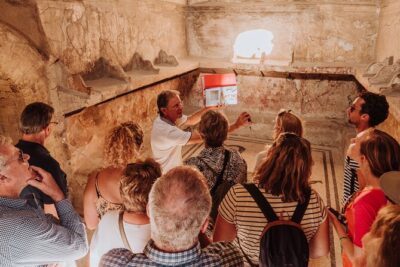
Herculaneum Small Group Tour and Ticket With an Archaeologist
Read our review →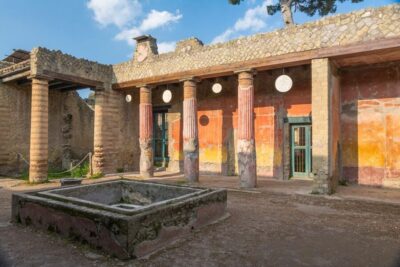
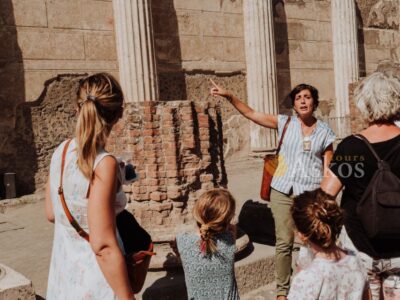
Pompeii & Herculaneum with Archaeologist Guide
Read our review →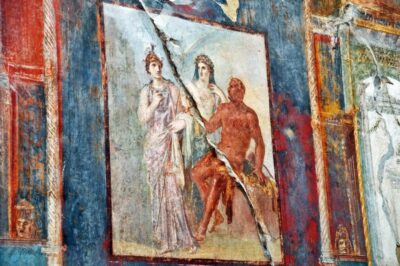
Pompeii, Herculaneum, & Vesuvius Full-Day Tour
Read our review →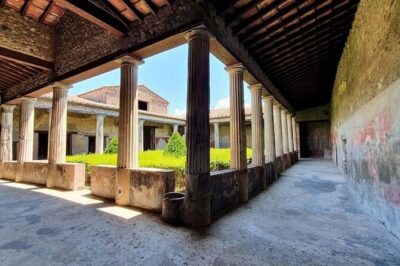
Day Trip of Pompeii, Herculaneum and Vesuvius from Naples
Read our review →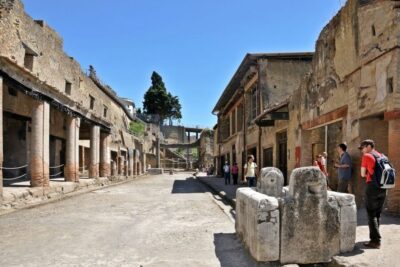
Pompeii & Herculaneum Day Trip from Naples with Lunch
Read our review →Browse the lists this tour appears in